

Smart Order Routing in Options Trading
Smart order routing shapes options outcomes by aggregating venues, cutting slippage and legging risk, and using AI to optimize execution.
Smart Order Routing (SOR) is an automated system that ensures your options trades are executed efficiently by scanning multiple venues - like exchanges, ECNs, and dark pools - for the best price and liquidity. It tackles liquidity fragmentation, where the same contract trades at different prices across venues, by choosing the lowest buy price or highest sell price in milliseconds.
Key benefits include:
- Better pricing: SOR uses aggregated data like NBBO to find competitive prices.
- Risk control: For multi-leg strategies, it executes all legs simultaneously via the Complex Order Book (COB), avoiding partial fills.
- Cost efficiency: It reduces market impact by breaking large trades into smaller chunks and prioritizing venues with lower fees.
Advanced SOR tools now incorporate AI, which dynamically adjusts routing based on market conditions, and customizable settings to align with specific trading goals. These systems are vital for managing risks, lowering costs, and improving execution quality in today’s fast-moving and fragmented markets.
How Smart Order Routing Works
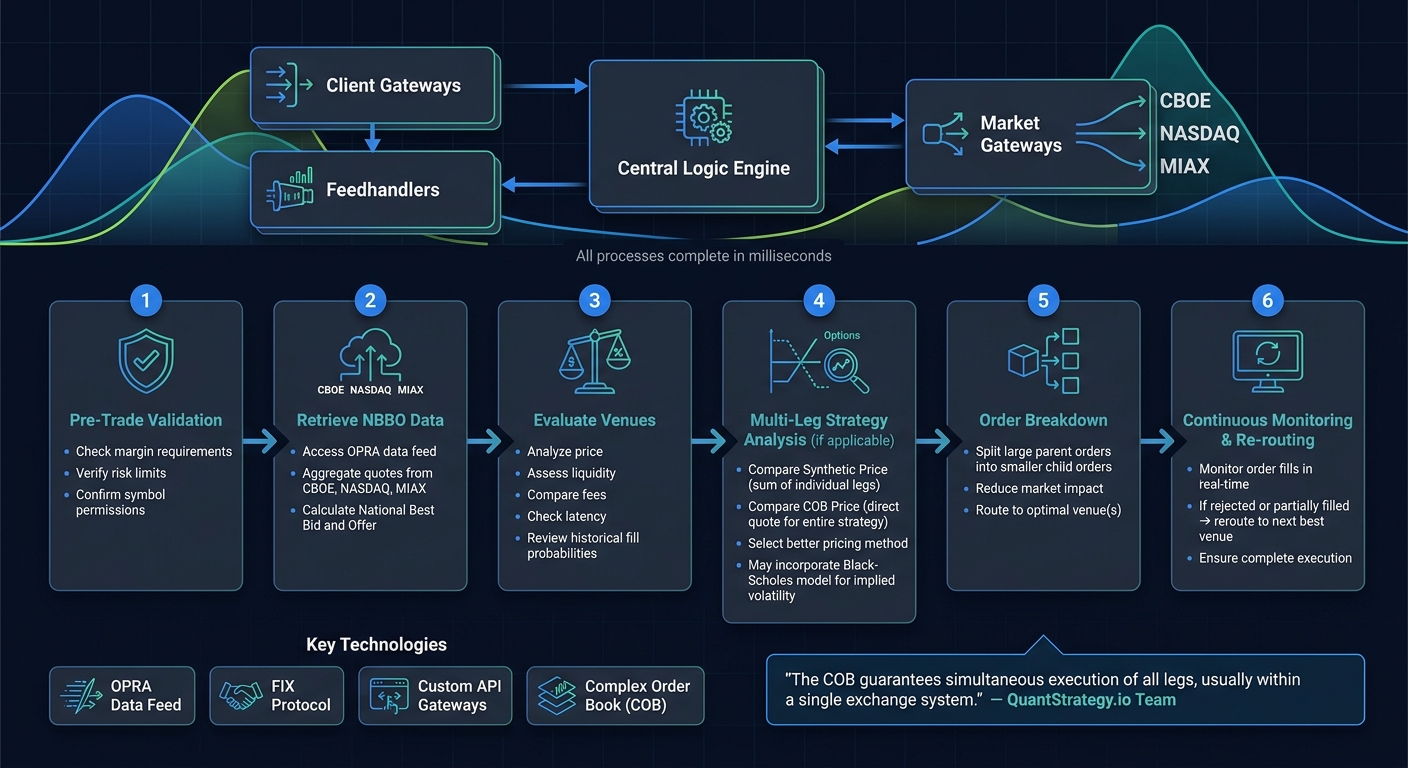
Smart Order Routing Process Flow for Options Trading
A smart order routing (SOR) system operates through a network of interconnected components designed to handle orders with precision and speed. It uses client gateways to receive orders, market gateways to send these orders to exchanges, feedhandlers to process real-time market data, and a central logic engine that determines the most efficient execution path. All of this happens in mere milliseconds to ensure the best possible execution.
The system relies on the Options Price Reporting Authority (OPRA) data feed, which aggregates quotes and trades from major U.S. options exchanges like CBOE, NASDAQ, and MIAX. This data is used to calculate the National Best Bid and Offer (NBBO), ensuring that routing decisions are based on the most competitive prices available. Connections to trading venues are typically made using the FIX protocol or through custom API gateways.
Order Routing Logic Explained
At the heart of the SOR is a decision engine that evaluates every incoming order with remarkable precision. It considers factors like price, liquidity, fees, latency, and historical fill probabilities to ensure efficient execution. For multi-leg strategies, the system compares two pricing methods: the synthetic price, calculated by summing the individual leg prices from simple order books, and the COB price, which represents the direct quote for the entire strategy on the Complex Order Book (COB). Since market makers can hedge combined strategies more effectively, the COB price often provides narrower spreads. Advanced systems may even incorporate the Black-Scholes model to factor in implied volatility when evaluating options prices.
Steps in the Routing Process
The routing process begins with pre-trade validations, which check for sufficient margins, risk limits, and permissions for the trading symbol. Once an order is validated, the system retrieves the latest NBBO data from the OPRA feed to determine the best available prices. It then evaluates potential trading venues based on these prices and other factors. For multi-leg orders, the system compares whether executing through the COB offers better pricing than trading individual legs separately.
After identifying the optimal path, the SOR breaks down large parent orders into smaller child orders to reduce market impact. During execution, the system continuously monitors order fills. If an order is rejected or only partially filled, the remaining quantity is rerouted to the next best venue. This dynamic approach ensures that even complex orders are executed with efficiency and precision.
Routing Complex Options Orders
Multi-leg strategies - like spreads, straddles, and butterflies - introduce unique challenges, particularly the risk of "legging." This occurs when market conditions change between executing the first and subsequent legs, potentially leading to unintended positions. To address this, smart order routers prioritize the Complex Order Book, which treats the entire strategy as a single executable unit.
"The COB guarantees simultaneous execution of all legs, usually within a single exchange system."
- QuantStrategy.io Team
This approach ensures atomic execution, meaning all legs of the strategy are executed at once, eliminating the risk of partial fills. Even when orders are divided into smaller chunks, each piece is routed as a complete strategy to maintain the intended net debit or credit. By executing all legs simultaneously, the Complex Order Book supports precise and risk-controlled trading.
sbb-itb-a9ac3c2
Benefits of Smart Order Routing for Options Traders
Smart Order Routing (SOR) brings more than just convenience to options trading. By improving trade quality, managing risks effectively, and cutting costs, it directly influences your profitability in fragmented markets.
Improved Execution Quality
SOR leverages NBBO aggregation and COB comparison to deliver better pricing. By automatically choosing the best execution path, it narrows spreads without requiring manual intervention to find the ideal venue.
Another key advantage is reduced slippage. SOR taps into deeper liquidity pools by breaking large orders into smaller segments and distributing them across various venues. This approach minimizes the market impact of sizable trades and ensures smoother execution.
Enhanced Risk Management
The atomic execution feature of COB, as mentioned earlier, protects you from legging risk. This ensures that multi-leg strategies execute fully at your intended net debit or credit, shielding you from market fluctuations during the process.
SOR also helps you stay compliant with regulatory standards like Reg NMS in the U.S., which requires brokers to seek the best execution for client orders. These systems create an audit trail that shows how they evaluated venues and selected the most efficient routing paths.
Moreover, advanced SOR systems include callback mechanisms. If an order is rejected or partially filled at one venue, the system automatically re-routes it to another. This ensures your trade continues seamlessly, even if an exchange faces technical problems or lacks sufficient liquidity.
Lower Costs and Faster Execution
Options trading can quickly become expensive due to transaction fees. SOR tackles this with cost-based routing, prioritizing venues with lower fees and better rebates. It calculates the total execution cost - including commissions, exchange fees, and clearing costs - and selects the most economical option that still matches your price criteria.
Speed is equally critical in fast-moving markets. Time-based optimization within SOR ensures that trades are executed quickly, capturing fleeting price opportunities before they disappear.
| SOR Type | Primary Focus | Key Benefit |
|---|---|---|
| Cost-based | Transaction fees | Reduces total execution costs |
| Time-based | Execution speed | Secures prices before they change |
| Liquidity-based | Order book depth | Limits slippage and market disruptions |
Advanced SOR Tools and Strategies
Building on the foundation of better execution quality and risk management offered by basic smart order routing (SOR), advanced tools take trade execution to the next level. Modern SOR doesn’t stop at selecting venues; it incorporates cutting-edge technologies like artificial intelligence (AI), customizable settings, and historical data analysis to refine strategies and improve outcomes.
AI-Powered Routing
Artificial intelligence has reshaped how trades are routed by adapting dynamically to market conditions. For complex multi-leg strategies like iron condors or butterflies, AI ensures all legs are executed simultaneously at optimal prices, significantly improving accuracy.
By 2026, AI is responsible for 89% of global trading volume, with the algorithmic trading market growing from $21.89 billion in 2025 to $25.04 billion in 2026 - a growth rate of 14.4% annually. AI systems go a step further by identifying when high-frequency trading algorithms might exploit your orders. They monitor execution quality in real time and adjust routing to avoid venues prone to adverse selection. During periods of high volatility or low liquidity, these systems quickly reroute orders to more reliable venues.
"AI now drives 89% of global trading volume, leveraging advanced algorithms, machine learning, neural networks and real-time data to automate trades and predict market movements."
– LiquidityFinder Research
In addition to AI’s adaptability, traders can fine-tune their strategies using customizable routing parameters.
Custom Routing Settings
Advanced SOR platforms allow traders to configure routing logic to align with their specific goals. For instance, you can prioritize speed for time-critical trades like 0DTE (zero days to expiration) options or focus on pricing efficiency for longer-term positions such as LEAPS.
For traders looking to reduce costs, these platforms enable routing of non-marketable limit orders to exchanges offering liquidity rebates under "maker-taker" models. Interactive Brokers reported that in April 2026, their clients achieved a net trading cost of just 0.024% of trade value using smart routing tools. Additionally, for large orders, "not held" instructions allow routers to search discreetly for hidden liquidity in dark pools and ECNs, reducing market impact.
Transaction Cost Analysis (TCA)
While real-time routing adjustments are essential, reviewing past performance through transaction cost analysis (TCA) helps refine future strategies. TCA evaluates key metrics like slippage, fill rates, fees, and order rejections to improve decision-making. This is crucial because poor execution can wipe out the gains from even the most accurate predictions.
In December 2025, a mid-sized hedge fund experienced a $3.2 million loss on a trade, despite the underlying stock moving 5% in their favor. The loss stemmed from an 8.1% total execution cost, which included 1.8% in market impact, 2.1% in slippage, and 4.2% in opportunity cost due to slow fills.
"Having the best signal is no longer enough. Execution has become the real edge."
– Pham The Anh
TCA also uncovers issues like "ghost liquidity", where orders appear on the book but disappear when execution is attempted. By analyzing venue-specific hit ratios over time, traders can avoid underperforming exchanges and focus on those with consistent fill quality.
Conclusion
Smart order routing (SOR) has reshaped how trades are executed, offering improved prices, reduced slippage, and minimized market impact. By aggregating liquidity across multiple venues, SOR becomes especially valuable for complex strategies, where managing risks like legging is critical.
AI has elevated trading by shifting the focus to execution quality. Decisions made in microseconds now determine whether a trade succeeds or fails. This advancement paves the way for tools that not only optimize execution but also uncover tailored trading opportunities.
For self-directed investors, SOR ensures trades are executed at optimal levels. Tools like ThetaEdge enhance this process by providing portfolio-aware analysis. By connecting to over 80 brokerages with read-only access, ThetaEdge identifies opportunities in strategies like covered calls and cash-secured puts, and multi-leg setups. Each recommendation comes with detailed breakdowns of risks, probabilities, and trade-offs. Together, intelligent routing and pre-trade analysis create a seamless workflow, improving both execution quality and overall outcomes.
Whether you're managing a simple portfolio or a web of complex positions, combining SOR with robust analysis tools ensures better execution and alignment with your broader trading strategy.
FAQs
How can I tell if my broker’s smart router is actually improving my fills?
When determining if your broker’s smart order routing is delivering better trade outcomes, focus on key metrics such as slippage, fill speed, and execution price relative to market benchmarks. If your trades regularly meet or exceed these benchmarks, it’s a good sign that the routing is working effectively.
Take advantage of tools like performance reports or analytics offered by your broker. These resources can help you monitor results over time and confirm that your trades are being executed at the best prices available in the market.
What’s the difference between routing a multi-leg order via the COB vs. legging in?
Routing through the Complex Order Book (COB) handles a multi-leg order as one unified transaction. This approach significantly reduces legging risk by ensuring all legs of the order are executed together or in a coordinated manner. By doing so, it minimizes exposure to price shifts that could work against you.
On the other hand, legging in executes each leg of the order individually. While this method can work, it exposes you to the risk of unfavorable price changes between trades, especially in fast-moving markets. It also adds an extra layer of complexity. COB routing tends to be the more efficient and lower-risk option.
Which SOR settings matter most for 0DTE options vs. longer-dated trades?
For 0DTE options, the most important SOR (Smart Order Routing) settings revolve around liquidity, bid-ask spreads, and timing. These trades thrive on higher liquidity, narrower spreads, and the rapid pace of time decay, making precision crucial.
In contrast, longer-dated options call for adjustments that account for lower liquidity, wider bid-ask spreads, and slower time decay. Fine-tuning these settings ensures better execution quality tailored to the unique characteristics of these contracts.