

Mastering Emotional Control in Options Trading
Manage fear, greed, and overconfidence in options trading with written plans, strict risk rules, trade journaling, automation, and mindfulness.
Trading options can be highly rewarding, but emotions like fear, greed, and overconfidence often lead to costly mistakes. Success in this field isn’t just about technical skills - it’s about staying disciplined under pressure. Here’s a quick breakdown of how emotions impact trading and how you can maintain control:
- Fear: Leads to premature exits or over-hedging during losses.
- Greed: Causes over-leveraging or chasing profits beyond targets.
- Overconfidence: Often follows winning streaks, resulting in excessive risks.
To manage emotions effectively:
- Create a written trading plan: Define clear rules for entries, exits, and risk management.
- Apply strict risk controls: Limit position sizes and set stop-losses to prevent emotional decisions.
- Use tools and technology: Automate repetitive tasks and rely on data-driven insights to reduce bias.
- Track performance: Keep a trading journal to identify emotional triggers and refine strategies.
- Focus on mental and physical health: Practice mindfulness, get enough sleep, and stay active to improve decision-making.
The key takeaway? Discipline and structured systems are more important than market predictions. Even the best strategies fail if emotions take over.
How Emotions Affect Options Trading Decisions
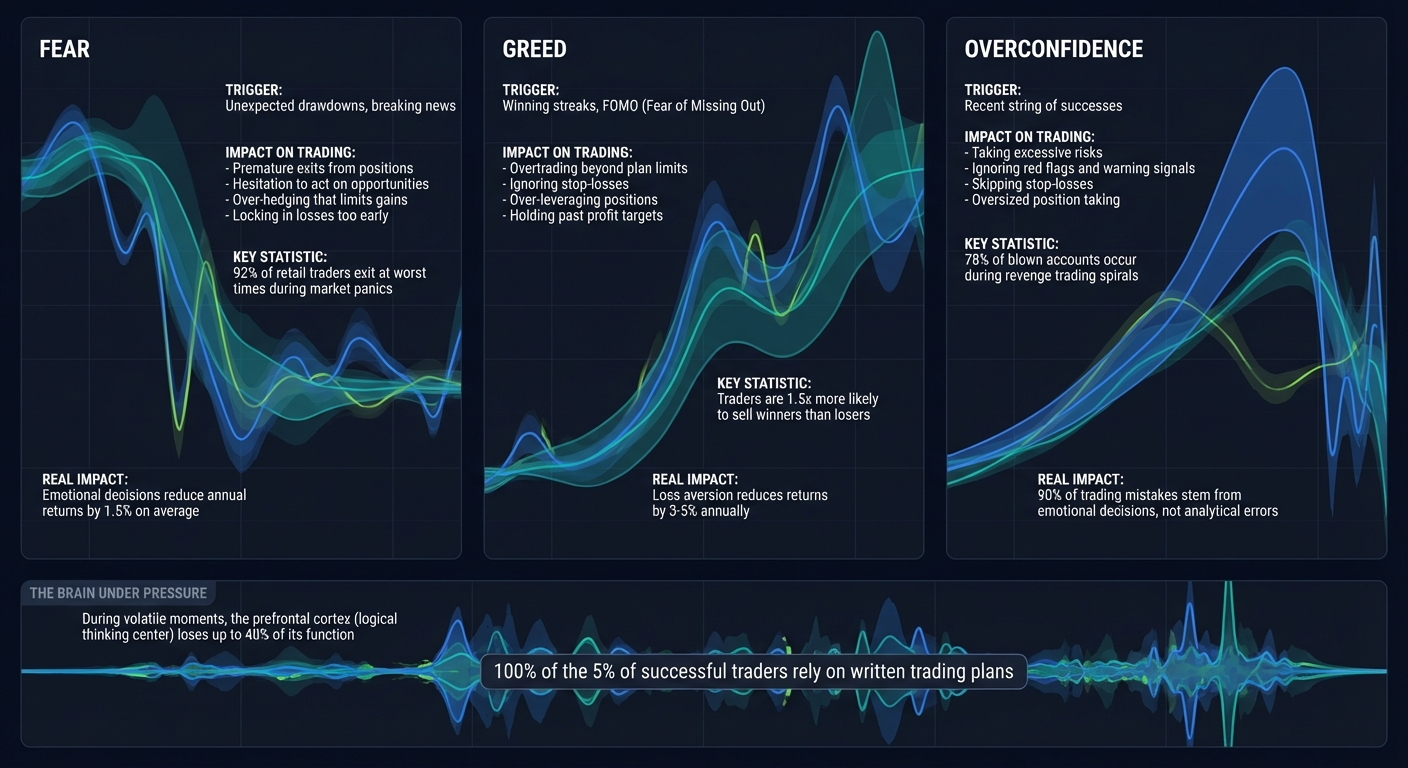
How Fear, Greed, and Overconfidence Impact Options Trading Decisions
When markets move quickly, emotions can take over. Watching your position gain or lose hundreds - or even thousands - of dollars in moments can make it hard to think clearly. Research shows that 90% of trading mistakes come from emotional decisions, not analytical ones. During these volatile moments, the prefrontal cortex - the part of your brain responsible for logical thinking - can lose up to 40% of its function.
This isn't just theory. In 2025, Alex, a Nasdaq day trader from Miami, learned this the hard way. After losing $2,000 on a Tesla short, he let emotions take over and doubled down. Within hours, his account shrank from $125,000 to just $25,000. This wasn't about bad analysis; it was emotional revenge trading.
Let’s break down how fear, greed, and overconfidence interfere with sound trading decisions.
Fear and Greed: The Two Primary Emotions
In the fast-moving world of options trading, fear and greed are constant hurdles. Fear can make you exit trades too soon, locking in losses. This is common when managing complex positions like a covered call strategy, where the fear of assignment can lead to premature exits. A sudden drawdown or unexpected news can trigger panic, leading to rushed decisions or over-hedging, which can limit potential gains.
On the flip side, greed pushes you to take on too much. After a string of wins, it’s tempting to hold out for more, even when you’ve already hit your profit targets. This often leads to over-leveraging or expanding your positions beyond what’s sensible. For example, the CNN Fear & Greed Index stood at 43 as of February 2026, indicating moderate fear in the market. But individual traders often swing between extreme fear and greed.
The impact is real: 92% of retail traders exit trades at the worst possible times during market panics, and emotional decisions can shave 1.5% off annual investment returns on average.
"At Renaissance, we automatically scale back position sizes after big wins - the brain can't be trusted to self-regulate".
Loss Aversion and Trading Behavior
Loss aversion is another emotional trap, especially for options traders. Studies show that the pain of a loss is about twice as intense as the pleasure of an equivalent gain. This imbalance drives the "disposition effect", where traders sell their winners too early but hold on to losing positions, hoping for a turnaround.
Take Maria, a forex trader in Mexico City. In 2025, she disabled her stop-loss to avoid locking in a loss. That decision turned what should have been a manageable 1% risk into a 4.6% loss.
This behavior isn’t unusual. Traders are 1.5 times more likely to sell a winning position than a losing one. Unfortunately, this tendency can reduce annual returns by 3% to 5%. Loss aversion doesn’t just hurt your bottom line - it also distorts your risk tolerance, making you overly cautious after gains and recklessly aggressive when facing losses.
The Dangers of Overconfidence
Oddly enough, a winning streak can be more dangerous than a losing one. Success can breed overconfidence, leading you to overestimate your skills and underestimate risks. In this state, intuition often replaces data, and you might ignore warning signs that would normally give you pause.
Lucas, a crypto trader in São Paulo, offers a cautionary tale. In 2025, he turned $5,000 into $25,000 in just two weeks. Riding high on his success, he ignored bearish signals and took a position ten times larger than usual. When the market turned against him, he refused to exit, convinced his streak would continue. The result? He lost $50,000 in a single trade, wiping out his gains and his original capital.
Overconfidence often leads to skipping stop-losses and taking on oversized positions. Psychologist Daniel Kahneman explains this as "System 1" thinking - quick, emotional, and based on shortcuts. Effective trading, however, requires "System 2" thinking, which is slower and more deliberate. It’s no surprise that 78% of blown trading accounts occur during revenge trading spirals.
Here’s a quick overview of how emotions impact trading:
| Emotion | What Triggers It | How It Ruins Your Trades |
|---|---|---|
| Fear | Unexpected drawdowns, breaking news | Premature exits, hesitation to act |
| Greed | Winning streaks, FOMO | Overtrading, ignoring stop-losses, over-leveraging |
| Overconfidence | Recent string of successes | Taking excessive risks, ignoring red flags |
Understanding these emotional pitfalls is the first step toward regaining control in your trading decisions.
sbb-itb-a9ac3c2
Practical Techniques for Controlling Trading Emotions
Managing emotions in trading requires a structured approach to avoid impulsive decisions. Success depends on having a disciplined plan. Research shows that 100% of the 5% of traders who succeed rely on written trading plans, while 95% fail within their first year.
Let’s explore three practical methods to transform emotional impulses into disciplined actions. A well-crafted trading plan is your first line of defense.
Developing a Written Trading Plan
A trading plan serves as a safeguard against decisions driven by fear or greed. When emotions run high, your plan provides clear guidelines to follow.
"A trading plan is your roadmap to consistent profitability. Without a plan, you're not trading - you're gambling".
Your plan should address six key areas:
- Trading foundation: Define why you trade and set financial goals.
- Market selection: Identify asset classes, liquidity needs, and trading hours.
- Strategy and entry rules: Outline technical triggers and entry checklists.
- Risk management: Use standard formulas like the 1% rule for managing risk.
- Trade management: Establish monitoring and exit rules.
- Psychology safeguards: Include pre-market routines and emotional circuit breakers.
For example, the "3-Loss Rule" is an effective safeguard: if you experience three consecutive losses, stop trading for the day. After any loss, take a mandatory 30-minute break to reset mentally before considering the next trade. Additionally, rate your anxiety on a scale from 1 to 10 before trading; if it’s higher than 7, delay the trade.
Here’s a comparison of trading with and without a written plan:
| Trading Component | Without a Written Plan | With a Written Plan |
|---|---|---|
| Decision Basis | Intuition, "gut feel", or hype | Specific, measurable technical triggers |
| Risk Control | Arbitrary or no stop-losses | Fixed percentage risk per trade and strict limits |
| Reaction to Loss | Frustration, revenge trading | Acceptance of losses as part of the process |
| Mental State | High stress and anxiety | Confidence, calm, and discipline |
Treat your trading plan as a dynamic document - review it weekly and refine it monthly based on insights from your trading journal. Many traders notice improved emotional control after consistently following their plan for 3 to 6 months.
Applying Risk Management Rules
Risk management is essential for protecting both your account and your mental well-being. Overexposing yourself to risk can trigger emotional responses, making rational decisions nearly impossible.
"Position sizing is the hidden edge. It transforms good strategies into sustainable businesses and prevents bad streaks from ending your career".
"The best traders don't avoid pain. They make sure the pain is survivable".
One useful tool is the "Sleep Test": if a trade size keeps you awake at night, it’s too large. Professional options traders often limit risk to 1–3% of their portfolio per trade. Studies reveal that 80–90% of options traders lose money over time, often due to poor risk management.
Some key risk management strategies include:
- Portfolio heat limits: Keep the combined risk of all open positions to 10–15% of your total account value. For example, if you hold positions in correlated stocks like AAPL, MSFT, and QQQ, treat them as a single risk to account for sector-wide downturns.
- Percentage-based stop-losses: Set stop-losses (typically 25–50% for options) at the time of entry to prevent emotional interference.
- Time-based exits: For options, close or roll positions at 21 days to expiration (DTE) to avoid the rapid time decay that occurs in the final 30 days.
If your account equity drops 10–12% from its peak, reduce position sizes to stabilize your confidence and account balance. Additionally, set a daily loss limit - usually 3% of your account - where trading halts for the day if reached.
The impact of position sizing on emotions is clear:
| Feature | Small Position Size | Large Position Size |
|---|---|---|
| Emotional State | Calm, bored, rational | Anxious, hyper-focused, reactive |
| Decision Making | Follows a pre-set plan | Impulsive, "fight-or-flight" |
| Market Volatility | Seen as data/noise | Seen as a personal threat |
| Longevity | High; survives drawdowns | Low; one bad streak can end a career |
"Your emotional state is usually a reflection of the risk you've taken on relative to the size of your account".
Keeping a Trading Journal
A trading journal transforms emotional experiences into actionable insights.
"Psychology isn't soft. It's data you haven't collected yet".
Log not just your trades, but also your reasoning and emotions behind them. Rate factors like confidence, stress, and urgency on a scale of 1 to 10 before and after each trade. Over time, patterns will emerge, showing how emotions impact your performance.
Use psychology tags such as [FOMO], [REVENGE], or [HESITATION] to label trades. Reviewing these tags can reveal trends - for example, trades tagged with [FOMO] may consistently result in losses.
Document additional factors like sleep quality, stress levels, and caffeine intake, as these can influence decision-making. Create a Yes/No checklist for every trade with questions like "Was the stop-loss placed immediately?" or "Did I follow my position sizing rules?". This helps measure how well you adhered to your plan.
Also, track the Maximum Favorable Excursion (MFE) - the highest profit achieved during a trade - and compare it to your actual exit price. This analysis highlights the "Fear Cost", or the profit lost by exiting prematurely.
Using Technology to Remove Emotional Bias
Technology acts as a buffer for emotions, enforcing predetermined stop-losses and take-profit targets. This reduces the need for constant manual monitoring, which can lead to fatigue and emotional decision-making. These tools complement a disciplined trading system built on structured plans and solid risk management. Advanced AI tools take it a step further by refining strategies and streamlining processes.
Modern trading platforms have transformed how options data is analyzed. Instead of manually sifting through probabilities or scrolling through endless options chains, AI-powered tools now highlight opportunities based on your actual portfolio. For instance, ThetaEdge connects with over 80 brokerages using read-only access, analyzing your specific holdings rather than generic market data. This eliminates irrelevant noise that often triggers FOMO (fear of missing out) or decision paralysis.
AI-Powered Analysis for Better Decisions
AI simplifies decision-making by providing precise calculations from live market data and your portfolio. ThetaEdge’s Thetix AI, for example, answers plain-English questions like, "Which covered calls offer the best risk-reward this week?" It delivers calculated responses rather than speculative guesses.
"AI That Calculates, Not Guesses... Verified numbers, not generated text." – ThetaEdge
The platform consolidates critical metrics - strike price, expiration, premium, probability of assignment, and breakeven - into a single view. This clarity helps avoid the emotional tendency to cherry-pick data that confirms biases. As of March 2026, ThetaEdge has analyzed over $26 million in assets for its members.
"ThetaEdge empowers [self-directed investors] to do it with the same tools the elite have always used." – Maxim Khailo, Founder & CEO, ThetaEdge
By clearly showing assignment probabilities - ranging from 5–10% for deep out-of-the-money calls to 70–90% for in-the-money calls - you can make decisions rooted in data, not anxiety. This transparency forces you to objectively assess trade-offs, understanding that higher premiums come with increased assignment risks.
Automating Repetitive Trading Tasks
Automation alleviates the emotional toll of constant decision-making. Predefined stop-loss and take-profit orders ensure that trades execute at specific levels, removing the temptation to second-guess your exit points due to fear or greed. Once these rules are in place, automated systems enforce them, helping you stick to your plan.
Platforms like ThetaEdge also automate covered-call screening, saving hours of manual labor. Instead of manually reviewing dozens of tickers, these tools scan your portfolio and identify opportunities that align with your criteria - whether you prefer conservative deep out-of-the-money calls or more aggressive at-the-money strikes. This automation reduces mental fatigue, which often leads to poor decisions later in the trading day.
Automated alerts for key price thresholds or implied volatility spikes keep you anchored to your strategy without the need for constant market monitoring. These alerts help prevent the psychological burnout that can arise when every market fluctuation feels like a potential threat.
Tracking Performance with Data
Replacing emotional interpretations with objective metrics is another way technology enhances trading. ThetaEdge’s income dashboard, for example, tracks exactly how much premium you’ve collected, while portfolio Greeks (delta, gamma, theta, vega) provide a clear view of your overall exposure.
Here’s how technology addresses specific emotional triggers:
| Emotional Trigger | Impact on Performance | Technological Solution |
|---|---|---|
| Fear | Exiting profitable trades prematurely; hesitation | Automated take-profit orders and probability metrics |
| Greed | Overtrading or increasing position sizes recklessly | Position size calculators and fixed risk-per-trade rules |
| Frustration | Revenge trading to recover losses | Digital journals to recognize triggers; automated "kill-switches" |
| Overconfidence | Taking unnecessary risks after a winning streak | Performance dashboards emphasizing long-term stats |
Tracking tools also reveal patterns you might otherwise miss. Recording your mental state - whether calm, rushed, or frustrated - alongside trade data can highlight emotional triggers that lead to poor outcomes. Over time, you’ll likely notice that trades made in a calm state outperform those executed in moments of stress.
"The most consistent traders I mentor are those who treat every trade like a business decision. They don't chase losses or celebrate wins - they just follow the system." – Dr. Henry Brooks, Financial Psychologist and Trading Behavior Expert
Technology also helps traders avoid overreacting to short-term results. Around 90% of options traders lose money because they react to emotional "noise" instead of focusing on long-term data. Performance dashboards that track win rates, average returns, and adherence to trading plans over months - not days - help shift the focus to the bigger picture.
Combining these data-driven insights with mental discipline creates a more resilient and consistent trading approach.
Building Mental Discipline for Trading
Discipline is what separates consistent traders from the rest, even with the most advanced tools at your disposal. While technology can crunch numbers and analyze data, it’s your mindset that ultimately drives execution. Building mental resilience isn’t about ignoring emotions - it’s about recognizing them before they influence your decisions. These practices can help you approach trading with clarity and control.
Mindfulness and Stress Reduction Techniques
When trades go against you, your body often reacts before your brain does. Your heart races, your palms sweat, and you might find yourself making impulsive decisions. Simple techniques like controlled breathing can interrupt this cycle. The 4-2-6 method - inhaling for 4 seconds, holding for 2, and exhaling for 6 - can calm your nervous system and restore focus during volatile trading moments.
Another helpful tool is the 60-second pause. When a trade takes an unexpected turn, set a timer for one minute and focus entirely on your breathing. This pause can prevent rash, revenge-driven actions that often lead to greater losses.
Daily mindfulness meditation can also improve emotional regulation, allowing you to observe market movements without reacting impulsively. A 2022 study found that traders who practiced mindfulness daily saw 25% fewer emotional trades and an 18% increase in annual returns. Taking a few moments before each trading session to visualize effective risk management and precise execution can prepare your mind for disciplined decision-making. Since mental calm and physical health go hand in hand, taking care of your body further strengthens your trading mindset.
Physical Health and Emotional Stability
Overlooking your physical well-being can undermine your ability to make sound trading decisions. Professional traders often prioritize getting 7–8 hours of sleep to maintain emotional stability and cognitive sharpness. Sleep deprivation heightens emotional responses and weakens the discipline needed to stick to a trading plan.
"Your body is your trading tool - neglecting physical health reduces cognitive function, impairs decision-making, and decreases emotional regulation." – Metafundfx
Incorporating regular exercise, balanced meals, and proper hydration into your routine can improve focus and reduce emotional swings. Even a quick 15–30 minute workout before the market opens can set a positive tone for the day.
Frequent breaks are equally essential. Taking time to reset your mindset every 2–3 hours - or immediately after a big win or loss - can stave off decision fatigue. Be mindful of caffeine intake, as too much can lead to jitters and energy crashes, clouding your judgment.
Setting Achievable Trading Goals
Clear, process-oriented goals can keep you focused on what you can control, rather than being distracted by market noise. For instance, instead of aiming to "Make $500 today", set goals like "Follow my entry criteria on every trade" or "Limit myself to a maximum of 3 trades per day". Process-based goals reduce emotional swings tied to profit targets and help you stay grounded.
Maintaining a trading journal can accelerate your progress. Research shows that traders who consistently document their trades improve three times faster than those who don’t. Writing down your mission - for example, "My goal is to replace my income by [Date]" - can serve as a guiding principle during volatile markets. Make your goals SMART: Specific, Measurable, Achievable, Relevant, and Time-bound.
Tracking your "Rule Adherence Rate" instead of just profit and loss can also reinforce discipline. Celebrate executing your strategy perfectly, even if the trade results in a loss. This mindset shift emphasizes skill over luck. Developing new trading habits typically takes 21 to 66 days, and using a habit tracker for routines like pre-market prep or post-trade reviews can help solidify these habits. Setting firm daily loss limits and capping the number of trades you take can further protect you from emotional burnout and revenge trading.
"The best traders are not the ones who know the most, but those who control themselves the best." – Jack Schwager, Author of Market Wizards
Roughly 90% of retail traders fail within their first year. The difference isn’t intelligence or market knowledge - it’s the mental discipline to follow a plan, even when emotions urge you to stray.
Conclusion
Gaining control over your emotions is what sets consistent traders apart from the majority who struggle. With 50–80% of trading success tied to psychology, even a flawless strategy can crumble under the weight of fear, greed, or overconfidence. Tools like written plans, strict risk management, mindfulness practices, and maintaining physical well-being form the foundation for handling market swings effectively.
Discipline is the cornerstone of success. Research indicates that planned trades achieve win rates of 55–60%, while trades driven by FOMO (fear of missing out) drop significantly to 28–35%. By implementing hard stops, keeping a dual journal to track both technical data and emotional responses, and taking a 60-second pause during high-pressure moments, you can create systems to counteract your brain’s instinctive reactions. Technology can further reinforce this discipline by simplifying and streamlining decision-making.
Platforms like ThetaEdge bring statistical probabilities, optimal roll strategies, and portfolio Greeks into focus, replacing guesswork with data-backed clarity. For example, viewing assignment probabilities as concrete figures instead of abstract fears, or relying on AI-generated insights from Thetix AI, shifts your strategy from emotional to logical.
As MRKT experts highlight:
"Emotional control isn't about suppressing feelings, it's about systems: Pre-defined rules, risk management, and information advantage remove the need for 'gut decisions'." – MRKT
FAQs
How do I stop revenge trading after a loss?
To avoid revenge trading, it’s essential to develop emotional discipline and stick to structured habits. Start by identifying what triggers impulsive decisions - whether it’s frustration, the need to recover losses quickly, or overconfidence. Commit to following a clear trading plan and use tools like stop-loss orders to manage risk effectively. Instead of seeing losses as failures, treat them as opportunities to learn and grow.
Keeping a trading journal can be a game-changer. By documenting and reflecting on your trades, you can uncover patterns in your behavior and refine your strategy. This practice helps you make more thoughtful, consistent decisions, steering you away from emotionally driven mistakes.
What risk limits should I use for options trades?
To keep risk in check when trading options, it's essential to establish firm boundaries. This includes setting maximum loss limits, managing controlled drawdowns, and using sensible position sizing. These practices not only protect your capital but also promote emotional discipline, which is key to staying consistent.
Experienced traders often stress the value of adhering to these guidelines. By sticking to your rules, you reduce the likelihood of making rash decisions and increase your chances of achieving steady, long-term results.
How can I use ThetaEdge to trade with less emotion?
ThetaEdge helps you approach trading with a clearer, more disciplined mindset by offering tools designed to support objective decision-making. With features like risk management strategies, Greek monitoring (such as Delta and Theta), and AI-powered insights, it minimizes the influence of emotions on your trades. By relying on data-driven analysis and structured plans, ThetaEdge empowers you to steer clear of impulsive choices and stay consistent in your options trading approach.