

5 Examples of Rolling Covered Calls Before Expiration
Five practical scenarios for rolling covered calls—how to roll up, out, up-and-out, down, or early to manage assignment and boost income.
Rolling covered calls is a strategy to adjust options positions when market conditions change. It involves closing an existing call and opening a new one with a different expiration, strike price, or both. The goal? To manage assignment risk, maintain income, or align your position with current market trends - often for a net credit. Here's a quick overview of five scenarios where rolling can make sense:
- Stock Rises Above Strike: Roll up to a higher strike to reduce assignment risk and allow for more upside.
- Extend Holding Period: Roll out to a later expiration to keep your shares and earn more premium.
- Strong Rally: Roll up and out to balance additional upside with income.
- Stock Pullback: Roll down or down and out to collect more premium on underperforming positions.
- Time Value Depletion: Roll early when most time value is gone to reinvest in a fresh contract.
Each approach depends on timing, strike selection, and maintaining a net credit. Rolling can help you refine your strategy, but always consider assignment risks, costs, and tax implications.
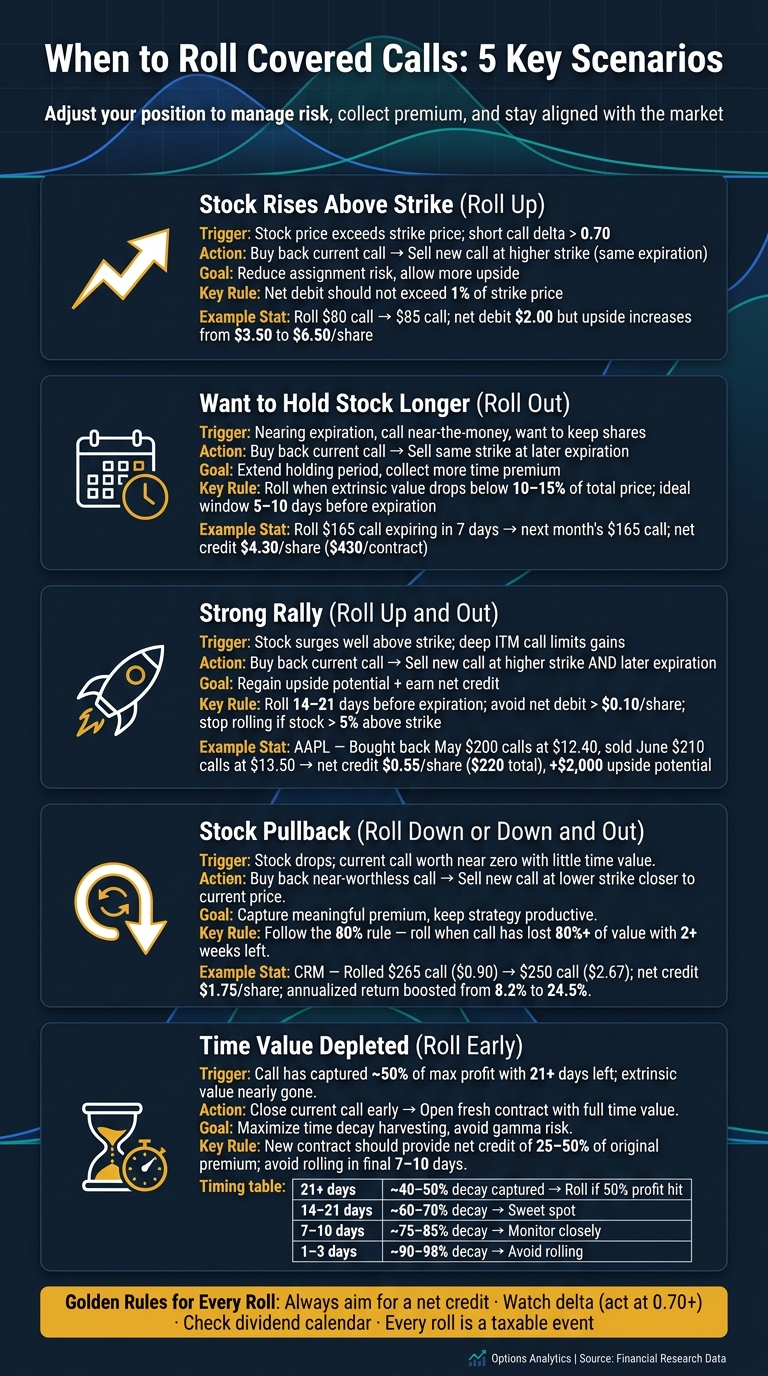
When to Roll Covered Calls: 5 Scenarios Explained
1. Rolling Up When the Stock Rises Above Your Strike
When the stock price climbs above your strike price, the risk of assignment increases. To manage this, you can roll up your position - buying back the current call and selling a new one with a higher strike. This adjustment keeps you in the trade while adapting to market changes.
Rolling up pushes the "cap" on your shares higher, reducing immediate assignment risk and allowing for more price growth. As Mike Thornton of The Multiplier explains:
"Rolling a call has one job: Reshape your position so it matches the market as it is today, not as it looked when you sold the original call."
That said, rolling up within the same expiration cycle often results in a net debit. For instance, imagine you bought 100 shares of XYZ at $79.00 and sold a March $80 call for $2.50. If the stock rises to $83.00, you might roll up by buying back the $80 call for $4.00 and selling a March $85 call for $2.00. This creates a $2.00 net debit but increases your potential profit from $3.50 to $6.50 per share.
A good rule of thumb: don’t spend more than 1% of the strike price in net debit when rolling up within the same expiration. If the cost exceeds that, consider rolling "up and out" to a later expiration. The added time value can help offset the expense of moving to a higher strike. Keep an eye on delta - a value over 0.70 suggests rising assignment risk and a need for action. Also, avoid waiting until the final week before expiration, as gamma spikes can make adjustments significantly pricier.
It's important to note that every roll triggers a taxable event. Closing the original call realizes a gain or loss, and selling the new call starts a fresh holding period. Additionally, if the stock has a dividend coming up and the call is deep in-the-money, the risk of early assignment increases. Always check the dividend calendar before rolling.
Next, we’ll look at strategies for extending your holding period when keeping your shares is the priority.
sbb-itb-a9ac3c2
2. Rolling Out When You Want to Hold the Stock Longer
Sometimes, you find yourself nearing expiration with your covered call trading at or near the money, but you're not ready to part with your shares. Maybe the stock has been climbing, and you believe there's still potential for further gains. In this scenario, rolling out - buying back the current call and selling a new one with the same strike price but a later expiration - can help you retain your shares while continuing to earn premium.
Let’s say you own 100 shares of Johnson & Johnson (JNJ) and sold a $165 call expiring in 7 days for $1.20. With the stock hovering near $164 and not wanting to risk assignment, you buy back the expiring call for $1.20 and sell the next month's $165 call for $5.50. This nets you a credit of $4.30 per share, or $430 per contract. By doing this, you extend your time horizon by about 30 days, reduce your cost basis, and postpone the possibility of assignment - all while keeping the strike price unchanged. This approach lets you take advantage of additional time premium, which is a key component of extrinsic value.
Extrinsic value plays a central role here. When you roll to a later expiration, the new option includes more time premium, making early exercise less appealing to the buyer since they’d lose that extra value. A helpful guideline is to consider rolling when the extrinsic value of your current call drops below 10–15% of its total price.
Timing your roll is critical. The sweet spot is usually 5–10 days before expiration, when roughly 75–85% of the option’s time decay has already occurred. Rolling too early sacrifices potential premium, while waiting too long can lead to wider bid-ask spreads and an increased risk of assignment. It’s also smart to check the dividend calendar. For example, if JNJ has an upcoming ex-dividend date and your call is in-the-money with minimal time value left, the buyer might exercise early to capture the dividend. Rolling before that date ensures you keep the dividend.
3. Rolling Up and Out After a Strong Rally to Balance Income and Upside
When a stock rallies significantly above your strike price, it’s time to adjust both upward and outward. Deep in-the-money calls can severely limit your gains, so rolling up and out becomes a smart move. This involves buying back your current call and selling a new one with a higher strike price and a later expiration. By doing this, you regain upside potential while also adding time value, often resulting in a net credit.
Let’s break it down with an example. In April 2025, an investor holding 200 shares of Apple (AAPL) at a cost basis of $192 had sold two May 16 $200 calls for $3.50 each, collecting $700 in premiums. By April 28, AAPL had surged to $211. To adjust, the investor bought back the May $200 calls for $12.40 ($2,480 debit) and sold two June 20 $210 calls for $13.50 each, bringing in $2,700. The result? A net credit of $0.55 per share ($220 total), a new strike price $10 higher, and an additional $2,000 in potential upside.
Timing matters here. Aim to roll 14 to 21 days before expiration. Waiting until the final week exposes you to gamma spikes - those sudden, unpredictable price swings in options - which complicates execution and increases costs. For deep in-the-money calls, watch the delta. When the short call’s delta hits 0.65–0.70, it’s time to act. This range signals a higher likelihood of assignment, so adjust promptly to avoid surprises.
"If the short call delta crosses 0.70, you are likely getting assigned. Adjust now or accept assignment intentionally - never accidentally." - CashFlowMachine
Stick to the net credit rule: experienced traders generally avoid rolls that result in a net debit greater than $0.10 per share. If the premium from the new call doesn’t cover the cost of closing the old one, reassess whether rolling is the right move. And remember, there’s a limit to how often you can chase a stock higher. If the stock climbs more than 5% above your short call strike, it might be time to stop rolling and accept assignment. This disciplined approach ensures you’re prepared for whatever the market throws your way.
4. Rolling Down or Down and Out After a Pullback to Collect More Premium
When a stock takes a significant hit, your covered call can lose most of its value, turning into a near-worthless position with little to no time value left. In this situation, rolling down (or down and out) allows you to close the stagnant call and replace it with a new one closer to the current stock price. This adjustment helps you capture a more meaningful premium, keeping your strategy productive.
Take May 2026 as an example. An investor holding a Salesforce (CRM) $265 strike call, now worth just $0.90 after a pullback, decided to buy it back and sell a $250 strike call for $2.67. This move resulted in a net credit of $1.75 per share ($175 per contract), boosting annualized returns from 8.2% to 24.5% - nearly tripling the income potential.
"A well-timed adjustment can boost your income, preserve upside potential, and keep your strategy working even when markets don't cooperate." - Gavin, OptionsTradingIQ
The downside? Lowering the strike price increases the likelihood of assignment. If the stock rebounds sharply, your shares might be called away before they recover to your original cost basis. This is the balancing act of rolling down: you increase your current income but give up some of the potential recovery gains. Before rolling down, ask yourself: are you okay selling at the lower strike? If you're banking on a strong rebound, it might be better to let the original call expire worthless and start over.
Timing is key. Follow the 80% rule: consider rolling when your current call has lost 80% or more of its value and still has over two weeks left until expiration. This approach can help you lock in more premium with a closer strike. Always aim for a net credit when rolling - avoid adjustments that require a debit.
5. Rolling Early When Most of the Time Value Is Gone
Sometimes, the smartest move isn't waiting for a dramatic stock shift - it's recognizing when an option has done its job. If a covered call has already captured most of its time value, holding it until expiration may expose you to unnecessary risk for very little additional reward.
When the option's extrinsic value drops significantly, it can be a good time to roll into a new position. A key guideline here is the 50% profit rule: if your call has reached 50% of its maximum profit and there are still 21 or more days left until expiration, rolling into a fresh contract may be a smart choice. Options tend to lose value faster in the final 30 days, so closing early allows you to reinvest in a new contract with full time value.
"Over 12 months, this approach [closing at 50% profit] often outperforms holding each position to expiration because you're constantly harvesting time decay at its optimal rate." - David Romic, Retail Options Trader
Timing is everything. Many traders identify the 14–21 days to expiration window as the ideal period for rolling early. Waiting too long, particularly into the final 7–10 days, exposes you to heightened gamma risk. During this time, even small stock price movements can lead to outsized changes in the option's price. Rolling before this period helps avoid these risks. Additionally, if the short call's delta exceeds 0.70, the likelihood of assignment increases, making an earlier roll even more appealing.
When rolling, ensure the new contract provides a meaningful net credit - ideally 25%–50% of the original premium received. If the roll barely covers transaction costs, it may not be worth the added effort.
"A roll that does not produce a meaningful net credit is usually not worth the operational complexity." - Mustafa Bilgic, CoveredCallCalculator.net
Here's a breakdown of how timing affects the time decay captured and the risks involved:
| Days to Expiration | Time Decay Captured | Recommended Action |
|---|---|---|
| 21+ days | ~40–50% | Roll if the 50% profit target is hit |
| 14–21 days | ~60–70% | Sweet spot - good balance of credit and risk |
| 7–10 days | ~75–85% | Final opportunity - monitor closely |
| 1–3 days | ~90–98% | Avoid rolling; high gamma risk and wide spreads |
Rolling early can help you make the most of your capital. By resetting the premium cycle with a new contract, you often achieve higher annualized returns compared to holding positions until expiration.
Conclusion
Rolling covered calls offers a way to adapt your strategy to changing market conditions. The approaches outlined earlier highlight how making thoughtful adjustments can help you navigate everything from capturing potential gains and extending holding periods, to balancing income with growth opportunities or rolling early when time value is nearly depleted.
The key to success lies in staying disciplined. Always aim for a net credit when rolling, and as Mike Thornton of The Multiplier explains:
"Rolling a covered call is just a simple trade adjustment: You close the call you have. You open a new one that fits the market better than the old one did."
There are times when letting your shares get assigned makes more sense - especially if the stock has surged past your strike price or if its fundamentals no longer align with your goals. The focus should always be on keeping your portfolio purposeful, rather than just staying busy.
FAQs
How do I choose the new strike and expiration when rolling a covered call?
When rolling a covered call, consider moving to a higher strike price if the stock has risen significantly. This allows you to regain some upside potential, typically aiming for a strike that’s 1–10% above the current stock price, depending on the size of the rally. For managing time decay, shift to an expiration date that’s 30–45 days out.
Make sure to aim for a net credit - the premium you collect from the new position should cover the cost of closing the old one and leave some profit. It’s also a good idea to make adjustments 14–21 days before expiration. This helps you avoid the increased risks that come with waiting too long.
When is it better to accept assignment instead of rolling?
When it makes sense to accept assignment depends on your goals and the situation. If you’re content with selling your shares at the current strike price or if the total return - combining share appreciation and the premium collected - outweighs what you’d gain by rolling the position, accepting assignment can be the smarter choice.
This approach is also practical when you’ve been using covered calls as a way to exit your position. It helps you avoid extending the trade unnecessarily, especially if the stock no longer aligns with your investment strategy or its fundamentals no longer justify holding it.
How do rolling covered calls affect taxes and dividends?
When it comes to rolling covered calls, both taxes and dividends can come into play. For dividends, if your short call option is in-the-money and has little time value left, there’s a strong chance of early assignment before the ex-dividend date. To avoid losing your shares, rolling the call to a later expiration date can be an effective strategy.
On the tax side, every time you roll a covered call, it creates a new transaction that could result in capital gains or losses. Additionally, this process can alter your cost basis. It’s a good idea to consult a tax professional to ensure you’re following IRS rules, including those related to wash-sale provisions, which could complicate things further.