

Stock Called Away? 5 Ways to Handle Early Assignment
Five practical strategies to handle early option assignment—reinvest proceeds, roll calls, sell cash-secured puts, use call spreads, or employ roll tools.
If your stock gets called away early due to an option assignment, it can disrupt your plans. But there are effective strategies to handle it. Early assignment often happens with American-style options, especially when the call option is deep in-the-money or a dividend payout is approaching. Here are five ways to respond:
- Reinvest Proceeds into New Covered Calls: Use the cash from the assigned shares to buy new stock and sell another call option. This helps generate monthly income from your portfolio.
- Roll the Short Call to a Later Expiration: Close the current call and sell a new one with a later expiration, potentially for a net credit.
- Sell a Cash-Secured Put: Write a put option on the same stock, setting yourself up to repurchase the stock at a lower price while earning premium.
- Adjust with a Call Spread: Reenter with a vertical call spread to maintain exposure while lowering risk.
- Use Advanced Roll Strategies: Platforms like ThetaEdge help you manage rolls effectively, balancing income and risk.
Each strategy has its pros and cons, but preparation and timely action are key to managing early assignments without major disruptions.
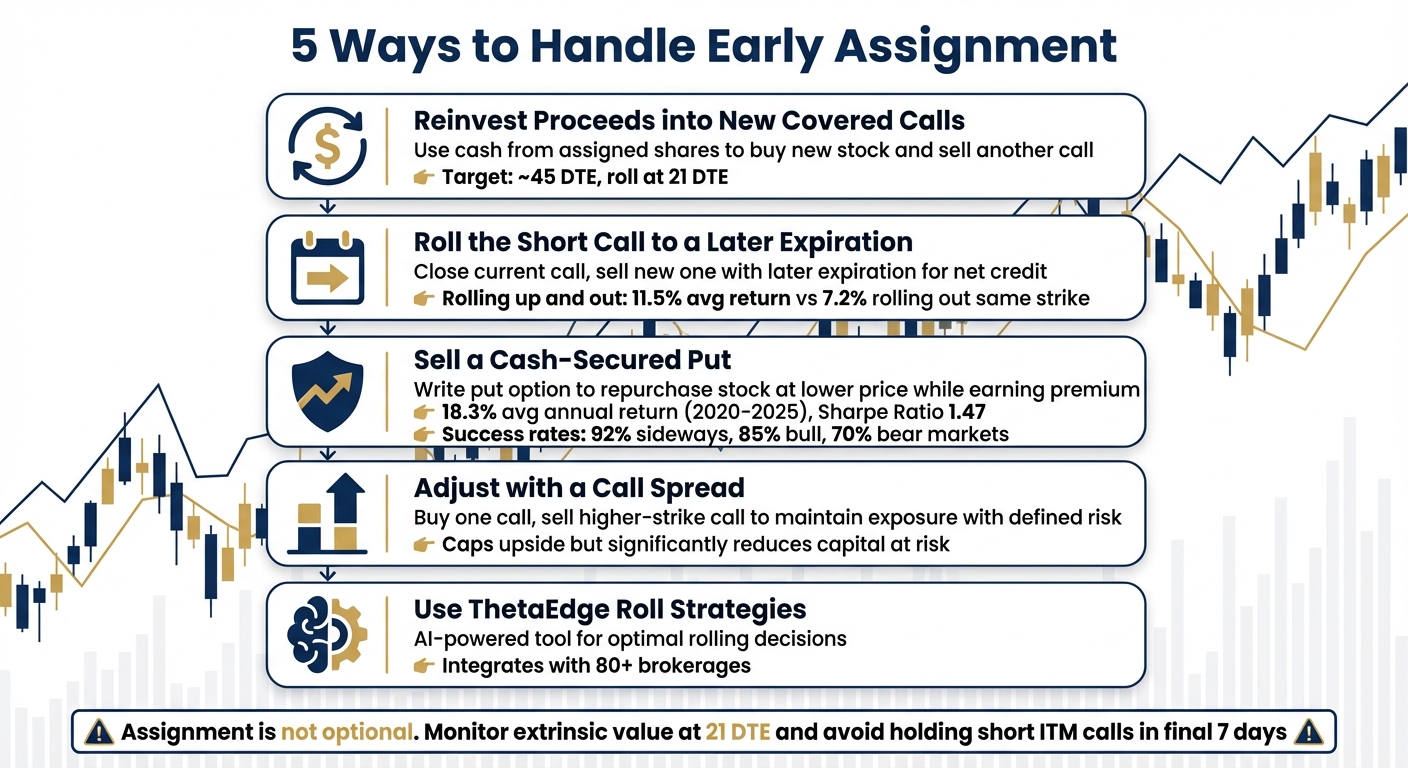
5 Strategies to Handle Early Stock Assignment in Options Trading
What Is Early Assignment in Options Trading?
Early assignment happens when the holder of an American-style option exercises their right to buy or sell the underlying stock before the option's expiration date. For instance, if you’ve sold a covered call, early assignment means you’re required to deliver your 100 shares at the strike price - even if you weren’t planning to sell them yet.
Most U.S. equity and ETF options are American-style, which means they can be exercised at any time. On the other hand, European-style options - like many index options such as SPX - can only be exercised at expiration. The Options Clearing Corporation (OCC) handles this process by randomly assigning exercise notices to brokerage firms, which then allocate them to customers either randomly or on a first-in, first-out basis. This flexibility in American-style options creates the possibility for early assignment.
Early assignment usually happens for a simple reason: the option’s extrinsic value is very low - typically less than $0.20. When an option is deep in-the-money and its price is mostly based on intrinsic value, the holder might choose to exercise early. Why? To free up capital, avoid bid-ask spreads, or - most commonly - capture an upcoming dividend.
"Assignment is not optional. You cannot refuse assignment if you're short. The OCC randomly assigns obligations among all short option holders." - Sharpnel Trading
The main factors that lead to early assignment are minimal extrinsic value, deep in-the-money status, and the chance to grab dividend payouts. These make exercising the option immediately more appealing than holding onto it.
sbb-itb-a9ac3c2
Why Does Early Assignment Happen with Covered Calls?
Covered calls can be assigned early for several reasons, including dividend capture, deep in-the-money (ITM) status, and market conditions. Each of these factors plays a unique role in increasing the likelihood of early assignment.
Dividend capture is a common driver of early assignment. When an upcoming dividend exceeds the extrinsic value of the call option, the call holder may exercise the option to become a shareholder before the ex-dividend date. For example, if a dividend payout of $0.72 surpasses the remaining extrinsic value of $0.44, early exercise becomes almost unavoidable.
"If the upcoming dividend amount is larger than the time value remaining in the call's price, it might make sense to exercise the option." - OptionsPlaybook
Deep ITM options also face heightened early assignment risk. As an option moves deeper ITM, its extrinsic value diminishes significantly, sometimes to as little as $0.10–$0.20. This drop in extrinsic value, combined with a delta nearing 1.00, makes early assignment more likely.
Market conditions further influence assignment risks. For instance, high interest rates can reduce call assignment risk because exercising requires a cash outlay, but they can increase put assignment risk by encouraging immediate cash acquisition. Additionally, high hard-to-borrow fees may act like a dividend, incentivizing early exercise to acquire shares. On the other hand, high volatility tends to increase extrinsic value, which lowers the chance of early exercise.
For income-focused investors who sell covered calls on dividend-paying stocks, timing is critical. As the ex-dividend date nears, they should monitor the extrinsic value closely. If it falls below the dividend amount, assignment becomes almost certain. A practical guideline: if the price of the corresponding put is less than the dividend, expect assignment. By understanding these triggers, you can better anticipate and manage adjustments to your covered call positions.
1. Reinvest Proceeds into New Covered Calls
If you're assigned early, you can keep your strategy rolling by reinvesting the proceeds into a new covered call position. The cash from the sale is available immediately, allowing you to act quickly. You can either reinvest in the same stock or choose another that fits your investment goals. This approach helps maintain cash flow while giving you the flexibility to fine-tune your strategy.
Income Generation Potential
Reinvesting keeps the income flowing. By quickly using your cash to repurchase shares and sell another call option, you avoid idle funds. A good rule of thumb is to target options with around 45 days to expiration (DTE). This timeframe allows you to benefit from theta decay, which accelerates as expiration approaches. To minimize the risk of assignment during expiration week, aim to roll or close your position when you reach about 21 DTE.
Alignment with Portfolio Objectives
Before reinvesting, take a moment to review your portfolio goals and follow a covered call checklist to ensure the trade still makes sense. If the stock's fundamentals have shifted or you've already hit your profit target, it might be smarter to move on instead of re-entering the same position. Whether you're focused on generating steady income with stable stocks or chasing growth with more volatile options, your goals will guide your choice of strike price and expiration date. This is one of several strategies you can use to handle early assignment effectively.
"Rolling is a skill that separates casual covered call sellers from professionals. It lets you stay invested, compound income, and avoid assignment when the stock is still healthy." – DaysToExpiry
Ease of Execution for Self-Directed Investors
Reinvesting is straightforward, especially with modern brokerage platforms. Many offer one-click orders that let you simultaneously buy 100 shares and sell a call contract, reducing the chance of slippage. To better manage assignment risk, avoid holding short calls past 7 DTE.
2. Roll the Short Call to a Later Expiration
Rolling a short call involves closing your current option while simultaneously selling a new one with a later expiration date. This strategy allows you to stay in the trade, aiming to collect a net credit - the difference between the cost of closing the old call and the premium received from selling the new one. That credit provides immediate income and extends the time frame for your trade to potentially succeed. Here's how this approach can work to your advantage.
Income Generation Potential
When you roll a short call to a later expiration, you're effectively selling more time value to the market. Longer-dated options come with higher extrinsic value, meaning you can secure additional premium. If you choose to roll "up and out" - opting for a higher strike price and a later expiration - you increase the potential for profit. For example, a 2023 study on covered call strategies for Salesforce (CRM) revealed that rolling up and out produced an average annualized return of 11.5%, compared to 7.2% for rolling out at the same strike price. This method not only allows you to collect premium but also lets you benefit from potential stock price appreciation.
"By rolling up and out, you're making a conscious trade-off. You might collect a smaller net credit than just rolling out, but you're giving yourself a shot at a much bigger profit if the stock keeps climbing." – Strike Price
Risk Management Effectiveness
Rolling your short call can help you avoid assignment while retaining your shares. As expiration nears, gamma risk increases, meaning your option's sensitivity to small stock price changes grows significantly. Rolling to a later expiration reduces this sensitivity, giving you more control over your position. Many professional traders evaluate their positions around 21 days to expiration (DTE) and avoid holding short in-the-money calls during the final 7 days. It's also crucial to check the ex-dividend date before rolling, as a dividend larger than the call's time value significantly raises the risk of assignment.
Ease of Execution for Self-Directed Investors
For individual investors, rolling a short call is now easier than ever, thanks to modern trading platforms. Most brokerages offer combo orders that let you execute both legs of the roll - buying back the old call and selling the new one - in one seamless transaction. This eliminates the risk of being exposed to market fluctuations between the two trades. To ensure a fair deal, use limit orders targeting the midpoint between the bid and ask prices. In 2023, traders on the Cboe executed approximately 1.2 billion option contract rolls, accounting for nearly 15% of the year’s total options volume. This growing adoption highlights how straightforward and effective rolling has become for self-directed investors.
3. Sell a Cash-Secured Put on the Assigned Stock
After being assigned, one way to approach a reentry is by selling a cash-secured put. This involves writing a put option on the same stock while setting aside enough cash to cover a potential purchase. Essentially, you’re being paid to wait for a more favorable entry point. This concept is central to the well-known "Wheel Strategy". Beyond generating income, this approach positions you for a strategic reentry into the stock.
Income Generation Potential
Even if the put option isn’t assigned, you still keep the premium earned. This premium effectively lowers your cost basis. For instance, if a stock is priced at $52, selling a $50 put for a $2 premium reduces your cost basis to $48 if assigned. Between 2020 and 2025, cash-secured put strategies delivered an average annual return of 18.3% on cash at risk, with a Sharpe Ratio of 1.47 - indicating strong, risk-adjusted results. This method not only generates income but also turns early assignment into a strategic opportunity.
"This strategy embraces assignment as a feature, not a bug. Works best on stocks you're comfortable owning long-term." – Sharpnel Trading
Risk Management Effectiveness
Managing risk with cash-secured puts starts with choosing the right strike price and monitoring the option's extrinsic value. Strikes set 5-10% out-of-the-money often yield premiums of 2.5-4.0%, with a 30-45% chance of assignment. Performance varies depending on market conditions: success rates are 92% in sideways markets, 85% in bull markets, and 70% in bear markets. To minimize risks, consider closing the position once you’ve captured 50-75% of the maximum profit. This frees up capital and reduces the risk of late-stage reversals. Even during challenging periods, like the 2022 tech selloff, this strategy demonstrated resilience, with a maximum drawdown of only 8.2%. These risk controls make cash-secured puts an effective tool for reentry when used thoughtfully.
Ease of Execution for Self-Directed Investors
Most brokerages make it straightforward to execute cash-secured puts by ensuring you have sufficient cash reserved for a potential stock purchase. Aim for expirations in the 15-30 day range, and focus on quality stocks you’re comfortable owning. To manage concentration risk, limit individual positions to no more than 5% of your total portfolio. If the put moves in-the-money, you can roll it to a later expiration and lower strike price, collecting additional credit while avoiding assignment at an unfavorable price.
4. Adjust Your Position with a Call Spread
When dealing with advanced roll techniques, a call spread can be an effective way to reposition after an early assignment. This approach allows you to re-establish a bullish stance without committing the full amount of capital. By creating a vertical call spread - buying one call and selling a higher-strike call - you maintain market exposure while reducing your overall risk. While this strategy caps your upside potential at the short call's strike price, it significantly lowers the capital you have at stake. It’s a smart choice for those seeking a cost-effective way to reenter the market instead of outright share purchases.
Risk Management Effectiveness
One of the main advantages of a vertical call spread is its defined risk structure, which is particularly useful after an unexpected assignment. For example, if you purchase a long call for $1.00 and sell a higher-strike call for $0.80, your maximum risk is limited to $0.20. This setup helps manage losses while still offering some upside potential.
"Treat any options trading adjustment as a new position. Map profit and loss exits as you would for any new trade." – Charles Schwab
If you’re assigned on the short leg of an existing spread, it’s essential to assess whether your long option still carries extrinsic value. In many cases, closing the long option and liquidating the shares separately can yield better results than exercising the long option. This approach helps capture any remaining time premium. By keeping risks defined, this strategy aligns with the goal of managing capital exposure while maintaining a bullish outlook.
Alignment with Portfolio Objectives
Call spreads are particularly appealing when you want to continue betting on a stock’s upward movement but prefer to reduce your exposure after an assignment. Selling the higher-strike call generates a credit, which lowers your cost basis and improves your breakeven point. This not only limits risk but also positions you more favorably. It’s an excellent fit if you believe the stock will rise further but want to protect yourself against a possible pullback. Additionally, most brokerages allow you to execute this adjustment in a single trade, which helps reduce both execution risk and commission costs.
Ease of Execution for Self-Directed Investors
Setting up a call spread is straightforward on most brokerage platforms. You can perform a roll up and out by buying back the assigned call and simultaneously selling a higher-strike call with a later expiration date. This often results in a net credit, effectively raising your sale price and adding income. To optimize this strategy, choose strike prices that align with your price targets and keep an eye on ex-dividend dates. If the short call’s time value drops below the upcoming dividend, you may face another early assignment .
5. Use ThetaEdge Roll Strategies for Portfolio Rebalancing

Rolling strategies can keep your portfolio working for you even after assignment. Instead of starting fresh, ThetaEdge's roll intelligence helps you reposition your investments while staying aligned with your market exposure goals. This AI-powered tool identifies when to roll out to a later expiration, roll up to a higher strike, or combine both moves to maximize premium income while maintaining exposure. Let’s look at how these strategies benefit income generation, risk management, portfolio alignment, and execution.
Income Generation Potential
Rolling turns a single covered call trade into a continuous income stream. By buying back a call that’s close to assignment and selling a new one with a later expiration, you can collect additional premiums. If the new call expires worthless, that premium becomes income. Rolling "out" to a later expiration often yields more premium than simply letting shares get called away and starting over. ThetaEdge’s income tracking dashboard highlights how these premiums compound over time, boosting returns without requiring extra capital.
Risk Management Effectiveness
Rolling also provides a way to adjust risk as market conditions shift. For example, if the stock price drops after assignment, you can "roll down" to a lower strike price, reducing your break-even point and limiting potential losses. ThetaEdge’s risk/reward analysis and assignment probabilities help you decide whether to roll or accept assignment, particularly around the critical 21-day mark before expiration. This timing helps you avoid the heightened gamma risk that occurs in the final week.
Alignment with Portfolio Objectives
ThetaEdge’s roll strategies allow you to maintain exposure to stocks you believe in, even after assignment. For instance, if your outlook changes from expecting modest gains to anticipating long-term growth, you can "roll up" to a higher strike price. This lets you capture more upside potential while still collecting premium income. The platform’s AI-generated action plans identify these opportunities, offering tailored roll suggestions that align with your goals. This is especially effective when using the "Wheel Strategy", where you can sell cash-secured puts after assignment to potentially reacquire the stock at a lower price as part of your reentry plan.
Ease of Execution for Self-Directed Investors
Executing roll strategies has never been easier. Many brokers now allow a single spread order to handle the "buy-to-close" and "sell-to-open" steps simultaneously. ThetaEdge integrates with 80+ brokerages, reducing execution risks and cutting commission costs. The platform’s Thetix AI assistant provides personalized guidance, helping you decide which roll makes sense for your situation - whether it’s rolling for a net credit to stay profitable or avoiding rolls when your stock thesis has changed. Aim to roll for a net credit or a minimal debit to keep the strategy working in your favor.
Conclusion
These five strategies help you navigate early assignment while staying in control. Each one supports different objectives, whether it’s generating consistent income, staying invested in the market, or managing risk when your outlook shifts. The key is to adapt your approach to fit current market conditions and your own financial goals.
Preparation is what sets successful options traders apart from those caught off guard. Once you’re short an option, assignment is part of the deal - you’re obligated to fulfill it. Your strategy should reflect your available capital, market confidence, and whether you prioritize income or growth. For instance, if you’re still bullish, rolling up and out can help you capture more upside and earn additional premiums. On the other hand, if your market view has changed or you’ve hit your profit target, accepting the assignment and moving forward may be the simpler option. Practical habits - like tracking extrinsic value and sticking to clear exit rules - can help you avoid surprises. Keep the 21-day mark before expiration in mind as a checkpoint to decide whether to roll or accept assignment.
FAQs
What are the risks of being assigned early in options trading?
Early assignment in options trading can throw a wrench into your plans if you're not ready for it. When you're assigned, you might suddenly need to buy or sell the underlying stock, which could mess up your strategy or create unexpected financial strain.
Take this scenario: if you're assigned on a short call, you might be forced to sell shares you don't even own. This could leave you in a short position or, worse, make you buy shares at a price higher than the current market value. On the flip side, being assigned on a short put could mean you're obligated to purchase shares. That might tie up money you had set aside for other investments.
The key here? Know the risks and prepare for the possibility of assignment. By doing so, you can manage your positions more effectively and keep your trading goals on track.
What are my options after my stock is called away due to early assignment?
When your stock is called away due to early assignment, what you do next will hinge on your financial goals and how you view the market. You have a couple of options: you could roll the option to a later date, continuing to generate income, or you might accept the assignment and use the proceeds to explore other investments that fit your portfolio strategy.
Think about whether your focus is on maintaining steady income, seeking growth, or rebalancing your portfolio. Each path has its own advantages, so take a moment to assess your priorities alongside the current market environment before deciding.
What should I keep in mind when rolling a short call to a later expiration date?
When rolling a short call to a later expiration, there are a few important factors to keep in mind to make the most of your position. One key metric is the option’s delta - try targeting a range between 0.55 and 0.65, as this often signals a good opportunity to roll. Another critical aspect is the remaining time value. If this drops to less than 10–15% of the option’s price, it could indicate that it’s time to take action.
It’s also essential to evaluate market conditions, the new strike price, and the updated expiration date. Balancing these elements can help you manage the trade-off between generating income and minimizing the risk of assignment. By considering these factors carefully, you can align your decisions with your overall trading strategy and portfolio objectives.