

How to Generate Monthly Income with Covered Calls
Learn a 4-step covered-call strategy to earn 1–3% monthly from stocks: pick stable shares, set strikes/expirations, execute trades, and roll positions.
Covered calls are a simple way to earn steady monthly income by leveraging stocks you already own. Here's how it works: you hold at least 100 shares of a stock and sell call options against them. This generates income through premiums, which can provide monthly returns of 1% to 3%. The strategy works best for stable, low-volatility stocks and is ideal in neutral or moderately bullish markets. While it limits your upside if stock prices surge, it reduces your cost basis and offers a buffer against minor price dips.
Key Steps:
- Choose Stable Stocks: Focus on blue-chip stocks with steady dividends and high liquidity.
- Set Strike Prices: Pick out-of-the-money strikes for balanced risk and income.
- Pick Expiration Dates: Use 30–45 day expirations to maximize time decay.
- Monitor and Adjust: Track positions, roll options if needed, and manage expirations.
Tools like ThetaEdge simplify this process by analyzing metrics like Delta and Theta, helping you optimize strike prices, track income, and adjust positions. By following this strategy, you can turn your stock holdings into a consistent income stream while managing risks effectively.
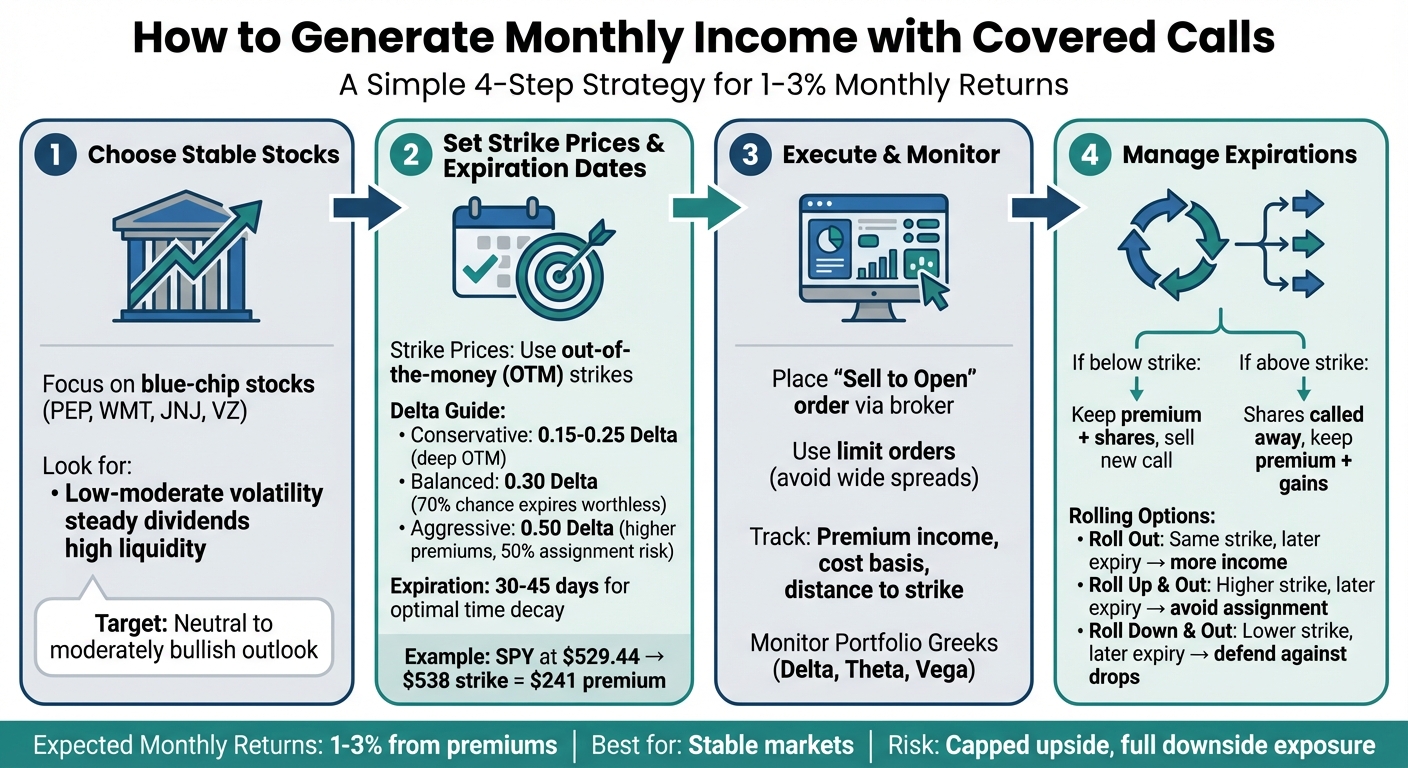
4-Step Process to Generate Monthly Income with Covered Calls
Step 1: Choose Stocks for Covered Calls
What to Look for in Stock Selection
When picking stocks for covered calls, focus on stable blue-chip stocks like PepsiCo (PEP), Walmart (WMT), Johnson & Johnson (JNJ), or Verizon (VZ). These stocks are known for their low to moderate volatility, making them ideal for this strategy.
"Covered calls are best deployed when you do not anticipate significant upward movement in stock prices, allowing you to capitalize on steady income through premiums." – Investopedia
Stocks with steady dividends are another great option since they can supplement the income you earn from premiums. Look for stocks with strong liquidity, meaning tight bid/ask spreads and high trading volume. It’s also smart to choose stocks with a neutral to moderately bullish outlook. Avoid stocks that are expected to surge in price, as this could limit your potential upside.
Now, let’s see how ThetaEdge simplifies this process.
How ThetaEdge Helps Screen Stocks
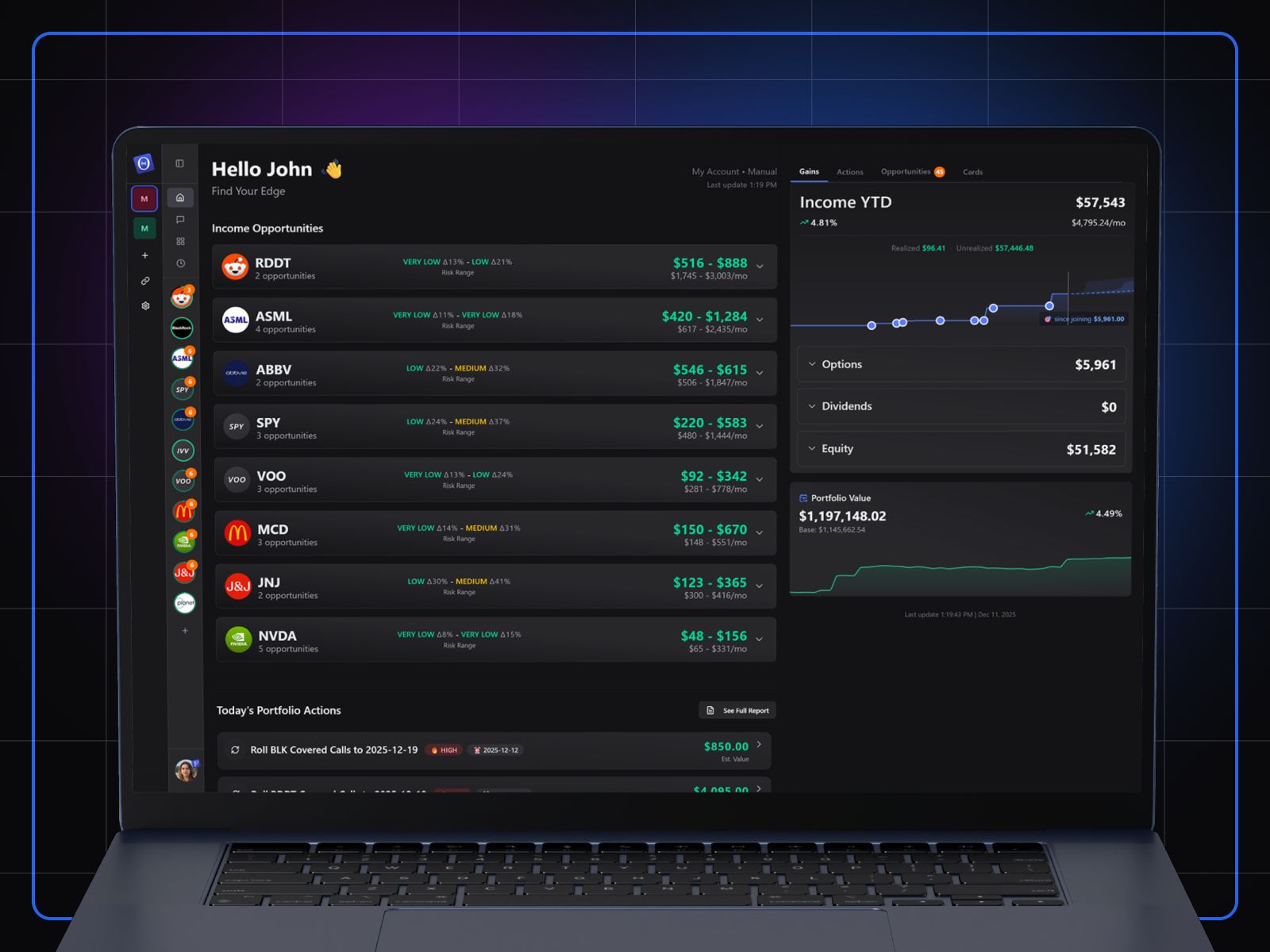
ThetaEdge takes these criteria and simplifies stock selection by automating the screening process. It evaluates your portfolio to find stocks that are well-suited for generating monthly income through covered-call strategies. The platform analyzes portfolio Greeks, particularly Theta (time decay), to identify positions where time decay works in your favor to enhance premium income.
ThetaEdge also uses Delta to estimate the likelihood of your shares being called away, helping you strike a balance between earning premiums and holding onto your stock.
Additionally, the tool identifies stocks with high implied volatility (IV rank above 50), which can help you capture higher premiums. For highly liquid stocks and ETFs like SPY or QQQ, ThetaEdge ensures that the bid/ask spreads are narrow, allowing for efficient trades. By tracking premium collection, the platform helps reduce your cost basis and provides clearer insights into your risk exposure.
Step 2: Set Strike Prices and Expiration Dates
How to Choose Strike Prices
Strike prices play a crucial role in determining the premium you collect and the level of risk you take in retaining your shares. Many investors opt for out-of-the-money (OTM) strikes - these are set above the current market price and allow you to earn premiums while keeping the potential for capital appreciation intact.
A helpful tool here is Delta, which estimates the likelihood of your shares being called away. For example, a Delta of 0.30 implies a 30% chance of assignment and a 70% chance that the option will expire worthless. Let’s break it down: If SPY is trading at $529.44 in May 2024, selecting a $538 strike (30–45 days out) with a Delta of –0.30 would offer a 74.75% probability of expiring OTM and could earn you $241 in premium.
For those looking to maximize income, at-the-money (ATM) strikes with a Delta near 0.50 provide higher premiums but come with a 50% chance of assignment. On the other hand, if you prefer a more conservative approach, aim for deep OTM strikes with a Delta between 0.15 and 0.25.
Once you’ve chosen your strike price, the next step is to decide on the best expiration date.
Pick Expiration Dates for Monthly Income
For consistent monthly cash flow, a 30–45 day expiration window is often the sweet spot. This range strikes a balance by maximizing Theta decay (the rate at which an option loses value as expiration nears) while still offering attractive premiums. Shorter-term options also tend to deliver higher annualized returns. For instance, a one-month $80 call on Facebook generated a 27% annualized return compared to just 12.3% for a 13-month $80 LEAPS call.
"The annualized return for a one-year option is much lower than if monthly options were written - check any options chain on any security." – Alan Ellman, President, The Blue Collar Investor
However, be cautious about expirations that coincide with earnings reports, as the increased volatility during these periods can lead to unpredictable outcomes.
With your strike prices and expirations in place, you can simplify the decision-making process by leveraging advanced tools.
Use ThetaEdge Metrics to Make Decisions
ThetaEdge takes the guesswork out of options trading by offering pre-calculated metrics like assignment probabilities and risk/reward profiles. Instead of manually analyzing Delta, Theta, and profit probabilities, the platform gives you instant insights tailored to your portfolio.
You can even simulate positions before committing. For example, ThetaEdge shows the premium you’d collect, the assignment risk, and how different strike prices compare. And if you’re unsure about a trade, Thetix AI can answer specific questions like, “What happens if the stock rises 5%?” - giving you actionable insights rather than just raw data.
Beyond that, ThetaEdge helps you stay ahead by tracking ex-dividend dates and earnings calendars, helping you avoid surprises like early assignments or unexpected losses.
Step 3: Execute and Monitor Your Positions
Place Trades Through Your Broker
After deciding on your strike price and expiration date, the next step is to execute the trade. Head to your stock's quote page on your brokerage platform and find the "Options" or "Option Chain" section. From there, select the expiration date and strike price you've chosen, and use the "Sell to Open" order action to sell the call option. To avoid unnecessary costs, always opt for a limit order instead of a market order. This helps you steer clear of losing premium due to wide bid/ask spreads.
Once the trade is executed, the option premium is credited directly to your brokerage account. This process mirrors the examples discussed earlier in the guide. Afterward, you'll be able to monitor your position's performance in real time.
Track Income and Performance
Keeping an eye on your positions means regularly reviewing important metrics like premium income (the amount you've collected), cost basis (your original stock price minus the total premiums received), and distance to strike (how far the stock price is from your strike price). To see how this strategy stacks up, calculate your annualized returns and compare them to other investment strategies.
Tools like ThetaEdge simplify this process by pulling data from over 80 brokerages into a single dashboard. With this platform, you can track your Portfolio Greeks (Delta, Theta, Vega), keep tabs on upcoming expirations, and pinpoint which stocks are generating the most income. As market conditions shift, these tools can help you adapt your strategy with ease.
Get Real-Time Guidance from Thetix AI
Markets can change in a heartbeat, making it tricky to decide when and how AI can maximize covered call returns. Thetix AI offers a solution by letting you ask straightforward questions like, "What are the risks to my income?" or "Should I roll this position?". It responds with actionable insights to help you make informed decisions. Additionally, Thetix delivers daily AI-generated action plans straight to your inbox. These updates highlight expiring positions and suggest trades to consider for the day.
"With Thetix you can ask trading questions in plain language - about opportunities, risks, or portfolio income. It responds with clear, actionable cards so your decisions are always informed, confident, and under your control." – ThetaEdge
If a stock nears your strike price and you want to hold onto your shares, Thetix can evaluate rolling options. It breaks down scenarios like rolling out (extending the expiration date), rolling up (choosing a higher strike price), or rolling down (choosing a lower strike price). You'll also get a credit/debit analysis for each option to help guide your decision.
sbb-itb-a9ac3c2
Step 4: Manage Expirations and Adjust Strategies
What Happens at Expiration
When an option reaches expiration, there are three possible outcomes:
- If the stock price is below your strike price, the option expires worthless. You keep the entire premium and retain your shares, giving you the chance to sell another call the next month.
- If the stock price is above your strike price, your shares are called away. You deliver them at the strike price but still keep the premium and any capital gains up to that strike.
- If the stock price equals the strike price, assignment isn’t guaranteed. However, automatic exercise generally occurs if the stock is even $0.01 above the strike price.
If assignment seems likely or you want to keep generating income, rolling your options could be a smart move.
Roll Options to Continue Generating Income
Rolling a covered call gives you the chance to extend your position and keep earning income while avoiding the need to surrender your shares. This involves two steps: buying back (or closing) your current short call and then selling a new one with adjusted terms - such as a different strike price, expiration date, or both.
- Rolling out: Close your current position and sell a new call with the same strike but a later expiration. This lets you collect more time premium.
- Rolling up and out: Move to a higher strike price and later expiration. This is helpful when stock prices rise, as it preserves upside potential and avoids assignment.
- Rolling down and out: Shift to a lower strike price and later expiration. This is typically done to lower your breakeven point if the stock price has dropped.
| Strategy | Action | Goal |
|---|---|---|
| Roll Up | Higher strike, same expiry | Increase maximum profit potential |
| Roll Down | Lower strike, same expiry | Lower breakeven point |
| Roll Out | Same strike, later expiry | Extend duration for more income |
| Roll Up & Out | Higher strike, later expiry | Avoid assignment on rising stock |
| Roll Down & Out | Lower strike, later expiry | Defend against a price drop |
Keep in mind: Rolling out, down, or down and out usually results in a net credit. Rolling up often comes with a net cost, while rolling up and out can vary but often produces a credit.
ThetaEdge offers tools to simplify these decisions by providing real-time analytics.
Optimize Your Strategy with ThetaEdge
ThetaEdge takes your covered-call strategy to the next level. Its Roll Opportunities tool evaluates your positions at expiration and beyond, identifying those that may need adjustments. It suggests whether to roll up, down, or out, and includes detailed credit or debit analysis for each option. On top of that, the platform’s Income Tracking Dashboard offers a complete overview of your collected premiums and overall performance, helping you pinpoint which strategies are delivering the best results.
As Maxim Khailo, Founder & CEO of ThetaEdge, puts it:
"Running the hedge fund, I created institutional tools that could analyze thousands of scenarios in real-time... ThetaEdge empowers [self-directed investors] to do it with the same tools the elite have always used".
Risks, Rewards, and Best Practices
Understand the Trade-offs
When it comes to covered calls, balancing the potential risks and rewards is crucial for maintaining long-term success. While these strategies can create steady monthly income, they come with their own set of limitations.
The premium you collect from selling a covered call offers immediate cash flow, reduces your cost basis, and provides a small cushion against minor price drops. However, it also caps your profit at the strike price plus the premium. If the stock experiences a sharp rise beyond the strike price, those additional gains are out of reach. On the flip side, you still bear the full downside risk - any significant price drop could lead to losses that far exceed the premium you earned. Additionally, if your shares are called away, there may be tax implications, such as converting long-term capital gains into short-term ones, which could increase your tax liability. These trade-offs underscore the importance of carefully evaluating whether covered calls align with your income and risk management goals.
| Feature | Description |
|---|---|
| Income Generation | Provides immediate income, supplementing dividends. |
| Downside Buffer | Premium reduces cost basis, offering a cushion against small price declines. |
| Capped Upside | Limits profit to the strike price plus premium, meaning missed gains if the stock surges. |
| Full Downside Risk | Investors remain exposed to significant losses if the stock price drops sharply. |
| Tax Implications | Assignments may lead to short-term capital gains if shares are sold before holding them for a year. |
Follow These Risk Management Practices
To minimize potential downsides, proper risk management is essential. Start by diversifying your covered-call positions across different stocks and sectors. This reduces the risk of a single stock or sector significantly impacting your portfolio. Additionally, only sell calls on shares you're prepared to part with at the strike price - this ensures you won’t face unexpected losses or regret if the shares are assigned.
Timing matters too. Avoid selling covered calls right before earnings announcements or other major events that could cause sudden price movements. Another useful approach is the 50% rule: once your call option has reached 50% of its maximum profit, consider buying it back. This locks in gains while reducing the risk of a late-stage reversal. Lastly, always check ex-dividend dates. If the option’s time value is less than the upcoming dividend, there’s a higher chance of early assignment.
Improve Results with ThetaEdge
Using advanced tools can make your covered-call strategy more effective and reliable.
ThetaEdge offers a range of features designed to optimize your approach. With its data-driven insights, you can refine your strategy to adapt to changing market conditions. The platform provides professional-grade metrics, such as risk/reward ratios and assignment probabilities, giving you a clear picture of each trade’s potential outcomes. The Income Tracking Dashboard helps you monitor collected premiums and overall performance, making it easier to identify which strategies are working best. Plus, Thetix AI allows you to ask portfolio-specific questions and receive tailored advice on when to roll, close, or adjust positions. By integrating these insights into your risk management practices, you can better sustain and fine-tune your monthly income strategy.
Conclusion
Covered calls can provide a steady stream of monthly income through a straightforward four-step process: picking stable stocks you’re comfortable holding, setting strike prices that balance premium income with assignment risk, executing and monitoring trades, and managing expirations with adjustments or rolling positions. Success hinges on careful execution, from selecting Delta strikes to optimize risk, to using 30- to 45-day expirations to maximize time decay.
This strategy is all about balancing consistent income with risk management. By owning stable, high-quality stocks and selling calls against them, you can aim for monthly returns of 1% to 3% from premiums alone. This not only supplements dividend income but also lowers your cost basis, creating a dependable income stream - even in flat markets. The process becomes even more effective with tools designed to simplify and enhance your trading experience.
ThetaEdge takes much of the complexity out of the equation by identifying tailored opportunities within your portfolio. Its platform provides real-time metrics and actionable insights to help you make informed decisions. As founder Maxim Khailo puts it:
"ThetaEdge empowers [self-directed investors] to do it with the same tools the elite have always used".
With integrations across more than 80 brokerages, ThetaEdge offers a centralized dashboard and delivers daily AI-driven action plans straight to your inbox. Whether you're rolling positions to avoid assignment, tracking premium income, or analyzing portfolio Greeks, the platform streamlines the process while keeping you in full control through your existing brokerage.
FAQs
What risks should I consider when using covered calls to generate income?
Covered calls can be a practical way to earn extra income from your investments, but they aren’t without risks. One of the biggest concerns is that if the stock price shoots up well beyond the strike price, your shares could be called away. This effectively limits your profit potential, meaning you might miss out on larger gains if the stock performs exceptionally well.
On the flip side, while the premium you collect does offer some protection against losses, it’s not a complete safeguard. If the stock’s value takes a significant hit, the premium won’t fully cover those losses. This strategy tends to work best in markets that are stable or mildly bullish. However, in volatile or declining markets, the income from premiums may not be enough to balance out potential losses.
Before diving into covered calls, take the time to think about your own risk tolerance, how you view the market, and your broader investment goals. This will help you decide if this approach fits with your financial plans.
What are the best types of stocks to use for a covered call strategy?
When picking stocks for a covered call strategy, start with shares you already own that show steady or slightly upward growth potential. Stocks with low to moderate volatility are ideal since they’re less likely to have dramatic price swings, which could disrupt your income or force you to make adjustments. Shares from established, consistently performing companies often fit this strategy well.
It’s also important to choose stocks with liquid options markets. This means there’s enough trading activity to help you execute trades smoothly and at fair prices. By focusing on stable stocks with dependable performance, you can make the most of your covered call strategy while keeping risks under control.
What are the best tools to improve my covered call strategy?
To get the most out of your covered call strategy, having the right tools at your disposal can make all the difference. ThetaEdge is one such platform that stands out. It helps pinpoint covered-call opportunities tailored to your portfolio. With features like professional-grade analysis, detailed risk/reward metrics, and tools to monitor expiration dates, it simplifies position management, letting you trade with greater ease and confidence.
Beyond ThetaEdge, other tools can also prove invaluable. Dashboards for tracking market trends, volatility analysis tools, and options analytics can all help identify the best strike prices and expiration dates. These resources not only offer insights into market conditions but also help align your trades with your income objectives. By incorporating these tools into your strategy, you can make more informed decisions and unlock the full potential of your covered call approach.