

Dividend Yield Effects on Covered Call Strategies
How dividend yield changes covered-call income, early-assignment risk, strike choice, and ex-dividend timing.
A high dividend yield can add income to a covered call, but it can also make early assignment more likely. If the dividend is larger than the call’s remaining time value, the buyer may exercise before the ex-dividend date - and you can lose the dividend.
Here’s the short version:
- Your total return comes from three places: stock movement, call premium, and dividends
- Higher yield can help cash flow, but it does not remove the upside cap
- Early assignment risk is highest on in-the-money calls right before the ex-dividend date
- Out-of-the-money calls usually face less early assignment risk
- Expiration timing matters: ex-dividend week is often the danger zone
- Rolling may make sense if the call’s remaining time value drops below the dividend
- The right strike is one you’d be fine selling at, not just the one with the biggest premium
The main point is simple: premium alone is not enough. When I look at a covered call on a dividend stock, I need to weigh income, assignment risk, missed dividends, and the upside I give up.
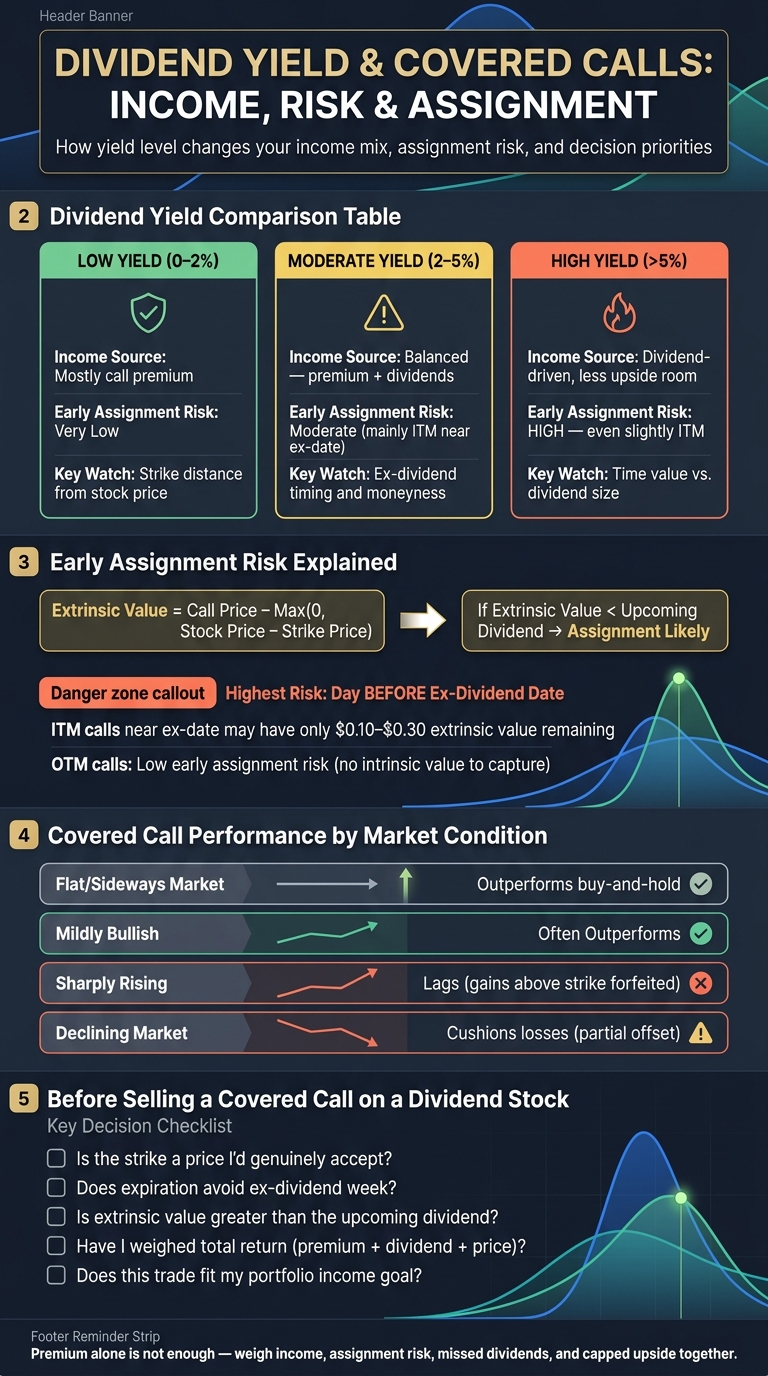
Dividend Yield & Covered Call Strategy: Income, Risk & Assignment Guide
Quick comparison
| Yield level | Income mix | Early assignment risk | What I’d watch most |
|---|---|---|---|
| 0%–2% | Mostly premium | Low | Strike distance from the stock price |
| 2%–5% | Premium + dividend | Medium | Ex-dividend timing and moneyness |
| Above 5% | More dividend-driven | High | Time value vs. dividend size |
A covered call can work well in flat or mildly bullish markets. But on dividend stocks, the trade changes near the ex-dividend date. That timing often decides whether the income you expect is the income you keep.
sbb-itb-a9ac3c2
What Research and Market Commentary Say About Covered Call Performance
These income trade-offs show up most clearly in the historical data. Covered calls have tended to do best in flat to mildly bullish markets. In sharp rallies, they usually fall behind buy-and-hold.
Where Covered Calls Have Historically Helped
The historical record gets pretty clear once you sort markets by trend. The pattern is simple: income matters more when price upside is limited.
| Market Condition | Covered Call vs. Buy-and-Hold | Why |
|---|---|---|
| Flat / Sideways | Outperforms | Premium and dividends provide return when price is range-bound |
| Mildly Bullish | Often Outperforms | Captures premium, dividends, and price gains up to the strike |
| Sharply Rising | Lags | Gains above the strike are forfeited to the option buyer |
| Declining | Can cushion losses | Premium and dividends partially offset the decline |
That lines up with how the strategy works in practice. If the stock goes nowhere, the premium and dividend income can do a lot of the heavy lifting. If the stock rises modestly, you may still keep the premium, collect the dividend, and participate in the move up to the strike. But if the stock takes off, the upside above the strike belongs to the call buyer.
Research also suggests that closing a short call after it has reached 50% of maximum profit can improve risk-adjusted returns. The logic is simple: once much of the premium has already been earned, keeping the position open can expose you to a late move that gives back part of the gain.
Why Dividend Stocks Often Appear in Covered Call Studies
That same income edge helps explain why dividend stocks show up so often in covered call studies. Dividend-paying stocks appear often because dividends and call premiums both add to total return. A higher dividend yield gives you more income cushion, but it does not change the upside cap.
There’s one catch that matters: if early assignment happens before the ex-dividend date, you lose the dividend. That detail can change the math, especially when the dividend is a meaningful part of the expected return.
How Dividend Yield Affects Income, Assignment Risk, and Total Return
Higher dividend yield can increase income, but it also makes early assignment more likely. Pair a higher-yield stock with call premium, and total cash flow can move up in a meaningful way. The catch is simple: the dividend can make your shares more likely to get called away early, especially the day before the ex-dividend date, if the dividend is greater than the call's remaining extrinsic value. That trade-off is exactly why strike choice and expiration timing matter.
| Yield Level | Income Effect | Assignment Risk | Decision Impact |
|---|---|---|---|
| Low (0–2%) | Income driven mostly by premium | Very low | Strikes can be set further OTM with less assignment concern |
| Moderate (2–5%) | Balanced income from premiums and dividends | Moderate; mainly if call is ITM near ex-date | Requires careful strike selection around ex-dividend dates |
| High (>5%) | High income, but less upside room | High; assignment likely even slightly ITM | Ex-dividend timing becomes the primary decision variable |
Higher Yield Can Boost Income but Not Always Net Results
More dividend income helps the cash side of the trade, but it doesn't remove the cap on returns. A covered call still has a ceiling. If assignment happens, your maximum gain is limited to the strike price, the premium received, and any dividend collected before assignment.
That matters because a high-yield stock can look better on the income line while still giving up upside if the shares move higher. More cash coming in doesn't always mean better net results.
Early Assignment Risk Rises Around Ex-Dividend Dates
Early assignment starts to make economic sense when the upcoming dividend is larger than the option's remaining extrinsic value. In plain English, the call buyer may choose to exercise early to capture the dividend.
This risk is most concentrated the day before ex-dividend. It's highest for in-the-money and deep in-the-money calls, where remaining extrinsic value may shrink to just $0.10–$0.30. At that point, the math can turn against the call seller pretty fast.
Out-of-the-money calls are a different story. They carry little early-assignment risk because there's no intrinsic value to give up by waiting.
Missing the Dividend Can Cut Expected Income
If your shares are called away before the ex-dividend date, you lose that dividend entirely. For higher-yield names, that can take a noticeable bite out of expected income.
When the dividend is large relative to the call's remaining extrinsic value, timing becomes the main issue. If the trade still matches your goal, you can roll to a later expiration or a higher strike to add extrinsic value and reduce early-exercise risk. Using an options strategy planner can help visualize these adjustments before execution.
Strike Selection and Ex-Dividend Timing
Early assignment usually comes down to a simple trade-off: is the dividend worth more than the option's remaining extrinsic value? That’s why strike price and expiration matter most. Those two choices shape whether you’re more likely to keep both the premium and the dividend - or lose the shares early.
Out-of-the-Money Calls vs. Lower Strikes
Strike selection changes assignment risk as the ex-dividend date gets close. OTM calls have no intrinsic value, so early exercise usually doesn’t make much sense. ITM calls are different. Near ex-dividend, they may have only $0.10 to $0.30 of extrinsic value left, and that can make early exercise worth it for the call holder.
Put plainly, strike price sets the risk, and expiration tells you when that risk shows up.
Matching Expiration to the Dividend Calendar
There are two common ways to handle the dividend calendar. You can let the call expire after the ex-dividend date to keep the dividend in play, or you can pick an expiration 2 to 3 weeks before ex-dividend to stay clear of that window.
The riskiest setup is a call that expires during ex-dividend week. By then, time value is often thin, so even a slightly ITM call can be assigned the day before ex-dividend.
When Rolling May Be Worth Considering
When the dividend starts to look bigger than the option’s remaining value, rolling becomes the next call. As ex-dividend gets closer, compare the call’s extrinsic value to the dividend with this formula:
Extrinsic Value = Call Price − Max(0, Stock Price − Strike Price)
If that figure falls below the upcoming dividend, assignment becomes more likely. At that point, you can:
- roll to a later expiration or a higher strike to add more extrinsic value above the dividend threshold, or
- accept assignment if the total return already hits your target
This is the part many traders miss. The premium isn’t the only number that matters near ex-dividend. Once extrinsic value slips under the dividend amount, the odds can change fast.
Risk, Reward, and Portfolio Fit
After strike selection and ex-dividend timing, the last step is simple: does this trade belong in the portfolio at all?
Main Risks to Weigh
Covered calls come with three clear trade-offs: capped upside, limited downside cushion, and dividend timing risk. You give up part of the stock's upside, and the premium only offsets losses to a point.
Near the ex-dividend date, early assignment can wipe out the dividend when the call's remaining extrinsic value falls below the dividend payout. In taxable accounts, nonqualified covered calls can also interrupt the holding period needed for qualified dividend treatment.
That changes the decision. The strike can't just look good on paper. It has to line up with a sale price you would honestly accept.
Where the Strategy Tends to Fit Best
Covered calls tend to fit best when an investor already sees the strike as a real exit price or a planned trim level on a position they would be fine selling. They often work best in flat, range-bound, or mildly bullish markets, where current income matters more than uncapped upside. They can also suit retirement-focused investors and core income portfolios that want both dividends and option premium.
That said, the trade-off never goes away. The overlay can lift portfolio income in a meaningful way, but it still limits upside.
Only sell calls on stocks you would genuinely be comfortable selling at the strike. If your main goal is long-term ownership and full upside participation, a dividend-first approach makes more sense. A covered call overlay fits better when you're willing to trade some upside for income now.
Key Takeaways on Dividend Yield and Covered Calls
Dividend yield can make covered calls look more attractive from an income standpoint, but it also changes assignment risk. When the expected dividend is larger than the call's remaining extrinsic value, early exercise becomes more likely.
So don't judge the trade by premium alone. Look at:
- Total return
- Assignment risk
- Portfolio fit
Higher yield can improve cash flow, but it also increases the chance of losing the dividend and giving up upside.
ThetaEdge can help review assignment probability, breakeven, and if-called outcomes across actual holdings.
FAQs
How do I know if early assignment is likely?
Early assignment is most likely when your short call is deep in the money, has very little extrinsic value left, and an upcoming ex-dividend date gives the call buyer a reason to take the shares early and collect the dividend.
One of the clearest warning signs is simple: the option’s remaining time value is less than the dividend amount.
At that point, the call holder may decide the dividend is worth more than staying in the option.
Should I avoid covered calls during ex-dividend week?
Generally, yes. If the call is in the money and its remaining extrinsic value is less than the dividend, early assignment becomes more likely.
That’s the setup traders watch during ex-dividend week. The call buyer may choose to exercise early to collect the dividend, which means your shares could get called away before the record date.
If your goal is to keep the dividend, avoiding covered calls during ex-dividend week can help cut that risk.
How do I choose the best strike on a dividend stock?
Choose your strike with three things in mind: the ex-dividend date, your income target, and whether you want to keep the shares.
A slightly out-of-the-money call - often around a delta of 0.20 to 0.35 - can offer a solid middle ground. You collect premium, but the odds of early assignment are lower than they would be with a closer or in-the-money strike.
That matters even more around the ex-dividend date. Deep in-the-money calls are more likely to be exercised early, especially when the dividend is in play. In plain English, if the buyer can take your shares and collect the dividend, they may do it.
If early assignment risk starts to climb, you may want to roll the call or close it before the ex-dividend date.