

Assignment Risk vs. Exercise Risk: Key Differences
Assignment (sellers' obligation) vs exercise (buyers' choice) in options — key triggers, timing, and practical risk-management tips.
When trading options, understanding the two main risks - assignment risk for sellers and exercise risk for buyers - is critical. Here's the core distinction:
- Assignment risk: Sellers face the obligation to fulfill the contract if the buyer exercises their option. This can lead to unexpected stock positions or capital requirements.
- Exercise risk: Buyers decide whether to exercise their option, often weighing profitability and timing. Poor decisions can result in missed opportunities or unintended stock exposure.
Key Points:
- Assignment risk applies to sellers who may be required to sell (calls) or buy (puts) 100 shares per contract.
- Exercise risk applies to buyers who must decide whether to act on their rights, forfeiting time value if they exercise early.
- Both risks peak near expiration or during specific events like ex-dividend dates.
Quick Overview:
- Sellers: Must monitor deep in-the-money options, low extrinsic value, and ex-dividend dates to reduce assignment risk.
- Buyers: Should avoid early exercise unless dividends or other factors outweigh remaining time value.
Managing these risks requires planning and awareness of key triggers, ensuring your portfolio stays aligned with your goals.
What is Assignment Risk?
Assignment risk arises when option sellers are required to fulfill the terms of a contract after buyers exercise their options.
"Assignment is when an option seller is obligated to fulfill that contract - either selling stock (assigned on calls) or buying stock (assigned on puts)." - QuantWheel
How Assignment Risk Works
When an option buyer exercises their contract, the Options Clearing Corporation (OCC) assigns the obligation to a seller holding a short position. This process is handled through the seller's brokerage and typically settles overnight (T+1). Brokerages may assign these obligations either randomly or on a first-in, first-out (FIFO) basis.
The seller's responsibility depends on the type of option sold:
- Call options: You must sell 100 shares of the underlying stock at the strike price.
- Put options: You must buy 100 shares at the strike price.
Assignments always occur in 100-share increments. At expiration, the OCC automatically exercises any option that is $0.01 or more in-the-money. This process, called "exercise by exception", makes assignment almost certain for in-the-money options at expiration.
Understanding these mechanics is key to identifying what increases assignment risk.
Factors That Increase Assignment Risk
Not all short options have the same likelihood of assignment. Several factors can make assignment more probable:
| Factor | Impact on Assignment Risk |
|---|---|
| Deep in-the-money (ITM) | The deeper the option is ITM, the more appealing it becomes for the buyer to exercise early. |
| Low extrinsic (time) value | When the time value approaches zero, exercising early has minimal cost for the buyer. |
| Ex-dividend dates | Call buyers may exercise the day before an ex-dividend date if the dividend exceeds the option's remaining extrinsic value. |
| High interest rates | Deep ITM put holders may exercise early to access cash sooner and earn interest. |
| Proximity to expiration | Most assignments - around 90% - occur near or at expiration. |
Another scenario to watch for is pin risk. If a stock closes exactly at the strike price on expiration day, after-hours trading could push it slightly in-the-money. In such cases, you may not know until Monday morning whether you’ve been assigned.
Recognizing these triggers is essential because assignment can have an immediate and significant impact on your portfolio.
How Assignment Risk Affects Option Sellers
Assignment can dramatically change your portfolio dynamics. A defined options position can quickly become a full stock position - 100 shares per contract - altering both your exposure and capital requirements.
- For put sellers: Assignment results in cash leaving your account while shares are added to your portfolio.
- For call sellers without the underlying stock: Assignment creates a short stock position, potentially leading to margin calls or forced liquidations if your account lacks sufficient buying power.
Another consideration is the adjustment to your cost basis. For instance, after a put assignment, your breakeven isn’t just the strike price - it’s the strike price minus the premium you collected. However, brokers often display only the strike price, so it’s up to you to manually track your actual cost basis for accurate tax reporting.
"Assignment risk is the primary reason option sellers require premium to compensate them." - Pomegra
sbb-itb-a9ac3c2
What is Exercise Risk?
Exercise risk applies exclusively to option buyers and revolves around the challenges of timing and decision-making when exercising an option. Unlike assignment, which is initiated by another party, exercising is entirely up to the buyer.
"Exercise is voluntary: Option buyers choose whether to exercise their contracts based on profitability." - QuantWheel
How Exercise Risk Works
Owning an option gives you the right to convert it into 100 shares of stock at the strike price. However, exercising early comes with a trade-off: you forfeit any remaining time value, capturing only the intrinsic value. In contrast, selling the option in the market lets you realize both intrinsic and extrinsic value.
"In the vast majority of cases, it is better to sell the option back to the market. Selling allows you to capture any remaining 'extrinsic value' (time value and volatility premium), whereas exercising only captures the 'intrinsic value.'" - ImpliedOptions Research
At expiration, any in-the-money option (even by $0.01) is automatically exercised. This can leave you with an unintended stock position if you haven’t closed the option beforehand. This shift doesn’t just affect your immediate returns but can also change your portfolio’s risk exposure, much like assignment risk does for sellers. Below are some conditions that amplify exercise risk for option holders.
Factors That Increase Exercise Risk
Certain scenarios make exercise risk more pronounced for buyers:
| Factor | Impact on Exercise Risk for Holders |
|---|---|
| High time value | Early exercise is often a poor choice since selling the option preserves its time value. |
| Dividends | A large upcoming dividend may encourage early exercise of a call if the dividend payout exceeds the remaining time value. |
| Interest rates | Rising interest rates can make early exercise of deep in-the-money puts appealing, as accessing cash sooner might outweigh holding the option. |
| Deep in-the-money with low liquidity | Illiquid options with wide bid-ask spreads may leave exercising as the most practical exit strategy. |
| Expiration timing | Automatic exercise at expiration can result in unintended stock positions if not managed carefully. |
American-style options - common for individual stocks and ETFs - can be exercised anytime before expiration. On the other hand, European-style options, like SPX index options, are only exercisable at expiration. These are cash-settled, so timing risks don’t apply.
How Exercise Decisions Affect Option Holders
Making the wrong exercise decision can lead to unexpected stock exposure. For instance, exercising a call immediately makes you long 100 shares per contract, which requires significant capital. If your account doesn’t have the necessary buying power, you could face a margin call.
There’s also gap risk to consider. If you exercise after hours, you might hold the stock overnight. A sharp price movement before the market opens at 9:30 AM ET could leave you with limited options to mitigate losses.
Another important aspect is how exercising affects taxes. When you exercise an option, the holding period for the resulting shares resets. This can impact your eligibility for long-term capital gains treatment, as the clock starts on the exercise date - not when you originally purchased the option.
While assignment risk is a seller’s obligation, exercise risk stems from the buyer’s decisions. Both carry real consequences for your portfolio, making it critical to weigh your options carefully.
Assignment Risk vs. Exercise Risk: Key Differences
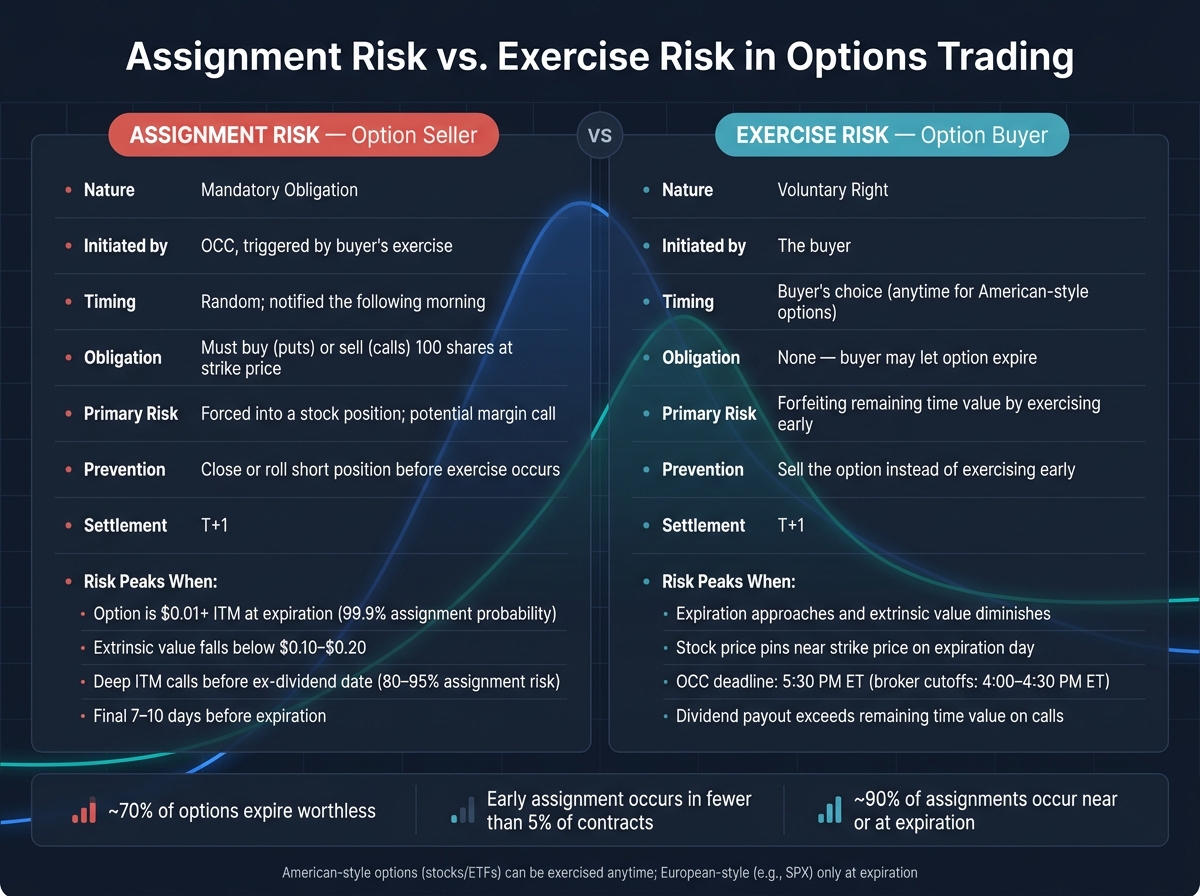
Assignment Risk vs. Exercise Risk: Options Trading Comparison
Comparison Overview
At their core, these two risks reflect opposite roles in an options contract. Exercise risk applies to the buyer, while assignment risk falls on the seller. One involves making a decision, while the other involves fulfilling an obligation.
"Exercise is voluntary: Option buyers choose whether to exercise their contracts based on profitability... Assignment is mandatory: Option sellers don't choose when they're assigned." - QuantWheel
For buyers, exercise risk is about deciding when to act on their rights. On the flip side, assignment risk means sellers must comply with the buyer's decision. Once a buyer exercises their option, the OCC assigns a seller, and the seller is notified - usually by the next morning. There is no room for the seller to decline. As Interactive Brokers explains, "The holder or buyer of the option has all the rights, and the seller or writer has all the obligations."
This dynamic highlights the fundamental difference between the two risks. Timing, control, and potential portfolio impact vary significantly, as outlined below.
Comparison Table
| Dimension | Exercise Risk (Buyer) | Assignment Risk (Seller) |
|---|---|---|
| Affected party | Option holder | Option writer |
| Nature of action | Voluntary right | Mandatory obligation |
| Initiator | The buyer | OCC, triggered by a buyer's exercise |
| Timing | Buyer's choice (anytime for American-style) | Random; usually known the following morning |
| Obligation | None - the buyer may let the option expire without action | Must buy (puts) or sell (calls) shares at the strike price |
| Primary risk | Forfeiting remaining time value by exercising early | Forced into a stock position, potentially triggering a margin call |
| Prevention | Sell the option instead of exercising | Close or roll the short position before exercise occurs |
| Settlement | T+1 - one business day after exercise | T+1 - one business day after assignment |
Assignment typically happens after market hours, leaving sellers to discover they’ve been assigned the next morning. This is why proactively managing short positions is crucial - it’s far better to act ahead of time than to deal with the consequences after the fact.
When Each Risk Matters Most
In options trading, timing plays a crucial role in determining the level of risk for both buyers and sellers. The specific moments when these risks peak often depend on the mechanics of options contracts and the decisions traders must make.
When Assignment Risk Is Highest
For sellers, assignment risk becomes most pronounced under certain conditions, which can be monitored using portfolio intelligence tools. The most consistent trigger is expiration. According to the OCC's "Exercise by Exception" rule, any option that's in-the-money (ITM) by at least $0.01 at expiration is automatically exercised. If a short option is ITM at least $0.01 at the close, assignment is nearly guaranteed, with a probability of about 99.9%.
Another critical moment is the ex-dividend date. This can catch short call sellers off guard. If the dividend payout on a stock exceeds the remaining extrinsic value of the call, the holder has a strong financial reason to exercise early and collect the dividend. For deep ITM calls with less than $0.10 of time value remaining, assignment risk jumps dramatically - ranging between 80% and 95%.
When a short ITM option's extrinsic value falls below $0.10–$0.20, the position should be considered high-risk. Sellers need to be particularly cautious during the final 7–10 days of a contract's life, as risks tend to escalate.
On the other hand, option buyers face their greatest risks as expiration draws near, when timing becomes critical.
When Exercise Risk Is Highest
For buyers, exercise risk peaks in situations similar to those faced by sellers. As expiration approaches and extrinsic value diminishes, holding the option may no longer provide much benefit. Buyers must decide whether to exercise the option to capture intrinsic value, sell the contract, or let it expire.
Close-to-strike prices on expiration day add another layer of complexity. Pin risk and broker deadlines often force buyers into quick decisions, as after-hours price movements could impact profitability. Traders can use AI-powered portfolio analysis to model these scenarios in plain English. The OCC sets a final deadline for exercise instructions at 5:30 PM ET on expiration day, but many brokers impose earlier cutoffs - usually between 4:00 and 4:30 PM ET. Missing these deadlines means forfeiting the right to act, even if the position becomes profitable later.
"Exercise when keeping shares (or capturing a dividend) is worth more than selling the option's remaining extrinsic value." - VolRadar
Buyers also face the dividend scenario. A call holder positioned just before an ex-dividend date must assess whether the dividend payout exceeds the option's remaining time value. If it does, exercising early to acquire the shares and collect the dividend becomes the logical choice.
Managing Assignment and Exercise Risks in Your Portfolio
How These Risks Change Your Portfolio
Assignments and exercises can alter your portfolio in ways that may catch you off guard. For instance, when a short put is assigned, it transforms into a long stock position, tying up capital that could have been used elsewhere. Similarly, a short call assignment results in a short stock position, which comes with specific margin requirements. Under Reg T, holding short stock typically demands 50% margin, and if your account isn’t ready for that, you could face a margin call.
A critical factor to keep in mind is your cost basis. After an assignment, brokers often display the strike price as the purchase price. However, that’s not your actual cost basis - you need to subtract the premiums you collected to find your true breakeven. This is especially important when managing strategies like the Wheel, where multiple positions are active simultaneously.
"Assignment is part of the business, and if you trade long enough, you'll have to manage through this multiple times." - Kirk Du Plessis, Founder, Option Alpha
To minimize exposure, certain habits can help. For instance, consider closing or rolling your short positions when 21 days to expiration (DTE) remain. This is when gamma risk spikes, and the likelihood of assignment increases. For short calls, always check the ex-dividend date. If the dividend surpasses the remaining time value, it’s wise to close the position at least 2–3 days before the ex-date. And if you’re selling puts, ensure your account has enough cash on hand to cover the purchase of the shares (Strike Price × 100) before entering the trade. These nuances highlight the importance of tools that provide a clear, portfolio-wide view of risk.
Using ThetaEdge to Frame Assignment and Exercise Risk

Managing these risks proactively is key, but tracking all the moving parts manually can quickly become overwhelming. That’s where a platform like ThetaEdge steps in to simplify the process.
ThetaEdge focuses on portfolio-aware analysis, meaning it doesn’t just look at individual trades - it evaluates them in the context of your overall holdings. For every covered call or cash-secured put, it provides vital insights like assignment probability, breakeven points, and a detailed risk/reward breakdown. This eliminates the need to piece together the information yourself.
The platform connects securely to over 80 brokerages using read-only access, ensuring that all decisions remain in your hands. It also offers roll strategy tools that identify new opportunities as positions near expiration, allowing you to stay ahead of assignment risks rather than reacting after the fact. This kind of proactive management can make a big difference when juggling multiple trades.
Conclusion: Key Takeaways
The main distinction between buyers and sellers in the options market lies in control. Buyers have the choice to exercise their options - it’s a voluntary right. Sellers, on the other hand, must fulfill their obligations when assigned, with the timing dictated by the Options Clearing Corporation (OCC). This fundamental difference shapes how each side approaches risk management.
For sellers, this lack of control can have significant effects on their portfolios. For instance, being assigned on a short put can tie up a substantial amount of capital in a long stock position. Similarly, assignment on a short call can force a seller into a short stock position, often leading to higher margin requirements. Both scenarios can disrupt a portfolio if they aren’t anticipated.
As VolRadar explains:
"Assignment is a predictable outcome where you fulfill your contractual obligation, not a financial emergency." - VolRadar
Statistics reveal that roughly 70% of options expire worthless, and early assignment happens in fewer than 5% of contracts. However, for those caught off guard by assignment, the resulting capital demands or adjustments to cost basis can be an unwelcome surprise.
To manage these risks effectively, preparation is key. Before entering any position, ensure you understand your true breakeven point - for puts, this is the strike price minus the premium collected; for calls, it’s the strike price plus the premium. Additionally, keep an eye on ex-dividend dates for short calls and consider closing deep in-the-money (ITM) positions early. These proactive measures can help you stay ahead of potential challenges and maintain control over your trading strategy.
FAQs
Can I avoid assignment on a short option?
You can't back out once an assignment takes place - it's a binding responsibility for the short option holder. To sidestep assignment, you'll need to act proactively. This means closing your short position before it happens, either by buying to close your option ahead of expiration or avoiding early triggers, such as an ex-dividend date. Tools like ThetaEdge assist in navigating these risks by offering portfolio-focused insights customized to your specific holdings.
When does early exercise actually make sense?
Early exercise is a logical choice when the advantage of exercising outweighs the value you’d gain by selling the option. This usually happens in a few specific situations:
- Call holders aiming for dividends: If there’s an upcoming ex-dividend date, exercising early allows them to claim a dividend that’s worth more than the option's remaining time value.
- Deep in-the-money puts in high-interest conditions: Exercising these puts can provide immediate access to cash, which is particularly appealing when interest rates are high.
- Challenging bid-ask spreads: When the bid-ask spread is too wide, selling the option may not be worthwhile. Exercising becomes a practical way to directly deal with the underlying stock.
What happens if I’m assigned or auto-exercised after expiration?
At expiration, any long option that is in-the-money by at least $0.01 will typically be exercised automatically by the Options Clearing Corporation, unless you specifically direct your broker not to. For traders holding short positions, this means you could be assigned the obligation to either buy or sell shares at the strike price. This assignment might result in the creation of a stock position in your account, which could lead to a margin call if your account doesn’t have enough equity to cover it. It’s also important to note that short options come with assignment risk, even if they appear to be out-of-the-money.